
Art Under Permission
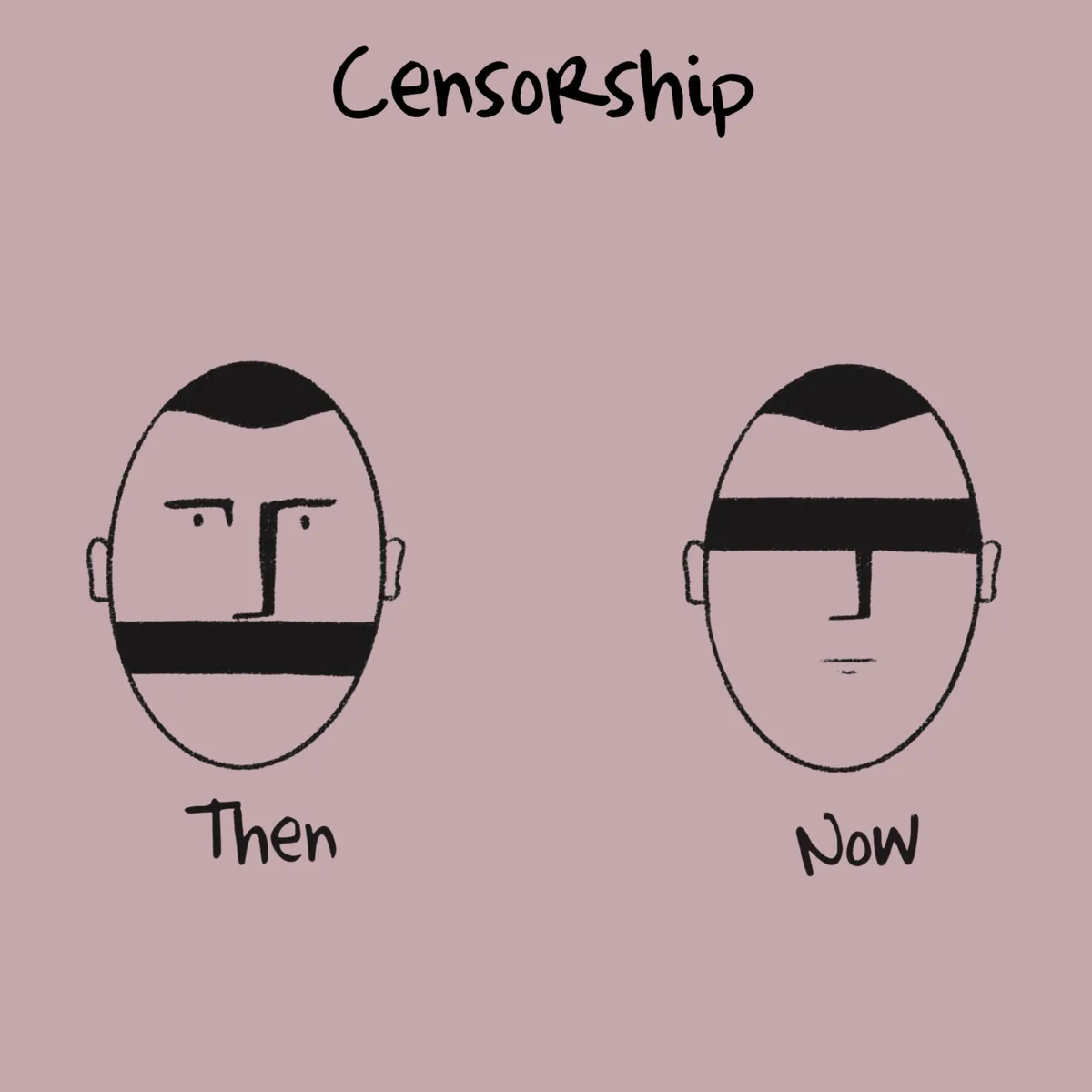
Under dictatorships, censorship was visible: you knew where the line was and what it would cost to cross it. In the liberal art world, control often works earlier and more quietly, shaping which work is seen, how it is framed, and whether it reaches an audience at all.
Published 16 September 2026James Baldwin once described the artist as "bearing witness ... to something which everybody knows, and nobody wants to face."
As a political artist, I built my work on that premise, drawing against Islamist rule in Sudan and military regimes across the region, where the limits were visible and the risks were clear. You knew when you crossed the line, and you knew what it could cost. Many crossed those lines and paid for it - with years in prison, or exile in the West, where we were told there would be space to continue the fight.
When I started, newspapers rejected my work. Painting in the street was too risky, so I moved into what felt like newly discovered territory: the early internet, blogs, virtual spaces where the work could exist with fewer restrictions.
At first, that space felt open. Over time, it narrowed. Platforms changed. Algorithms changed. Increasingly, publishing could feel like speaking into a void: no engagement, no resistance, no consequence. Only the people who already "like" your work, like your work.
It took me time to understand that this, too, can be a form of social control. The work does not have to be banned if it can simply be prevented from reaching people.
And when political artists like us are welcomed into the art world, the conditions often arrive with the invitation. We are brought in, sometimes in the name of expanding the institution's boundaries, only to find that the terms under which our work will be read have already been set.
Before the work is seen
When I arrived at documenta fifteen in 2022, that process became visible.
Months before the exhibition opened, accusations around antisemitism and alleged links to the BDS movement were already shaping its reception. One exhibition venue was broken into and vandalized with "187", a reference to the California penal code for murder. Meetings about artist safety were taking place before audiences had even encountered the work.
Then came People's Justice, a banner by the Indonesian collective Taring Padi, rooted in the group's struggle against dictatorship and militarism. One section of the work, which included imagery referencing Israel, was singled out and labeled antisemitic.
I disagreed with that reading. To me, the accusation stripped the imagery from the political history and visual language in which it had been produced and reduced an enormous anti-militarist work to a single interpretation. But once that interpretation took hold, there was little room left for argument. The work was covered, then removed. Soon afterward, documenta's general director left her position.
What followed was larger than a dispute over one image. The controversy came to shape the atmosphere around an exhibition involving hundreds of artists, influencing how the rest of documenta was seen, discussed and, in some cases, approached before the work itself had a chance to speak.
Four years later, I encountered a similar dynamic at the Biennale of Sydney, where I was invited to participate.
The world had changed. The art world had too, but the space available to openly political artists felt narrower.
Before the 2026 Biennale opened, attention had already fixed on its artistic director, Hoor Al Qasimi, an internationally recognized Emirati curator and member of Sharjah's ruling family. Her public support for Palestine became part of the controversy surrounding her appointment. Donors reportedly withdrew. Critics accused the Biennale of political bias. The institution even offered representatives of the Jewish community a walkthrough before the exhibition opened.
Again, the work was entering a space where its interpretation was already under construction.
Khaled Sabsabi's experience showed another version of the same instability. The Lebanese Australian artist was selected in early 2025 to represent Australia at the 2026 Venice Biennale. Less than a week later, following political controversy over earlier works, Australia's arts funding body rescinded his appointment. Months later, after an extraordinary backlash from artists and cultural institutions, he was reinstated.
Selection, removal and reinstatement had all become part of the public performance before the audience encountered the work.
In Sydney, I also spoke with the Australian street artist Scott Marsh, whose political murals have repeatedly been painted over, challenged or removed. In one documented case, police repeatedly pressed the City of Sydney over a Black Lives Matter mural showing a burning police car; it was removed within a day.
Street art makes the mechanism unusually easy to see. An image appears, pressure follows, and the image disappears. Interpretation barely has time to begin.
The Venice Biennale reveals another dimension of the contradiction. In 2024, amid calls for Israel's exclusion over the war in Gaza, the Biennale stated that any country recognized by Italy was entitled to request official participation. Political artists, meanwhile, can find their careers, invitations and institutional relationships subjected to intense scrutiny over their positions.
This is the fiction behind institutional "safety": that remaining neutral simply means avoiding controversy. Institutions make choices about what risks they will tolerate, whose discomfort matters, and which forms of political expression become liabilities.
The Palestine exception
These cases are not identical. But Palestine is where the contradiction becomes hardest to ignore.
Antisemitism is real, and its history carries a weight that cannot be dismissed. But criticism of Israel is not inherently antisemitic, just as criticism of a Muslim state is not inherently Islamophobic. Even criticism of a religion itself should remain protected speech.
Once those distinctions collapse, accusation can take the place of argument. The question stops being what a work says and becomes whether the work should have been allowed to speak at all.
As a cartoonist, I have watched political images acquire radically different meanings depending on who draws them and whom they offend.
I did not agree with the Muhammad cartoons, but I defended the right to draw and publish them. That distinction seemed clear to much of the Western cultural world at the time. Images were reproduced, enlarged and projected onto buildings. Cartoonists became symbols of artistic freedom.
That principle cannot depend on the identity of the artist or the object of criticism.
Today, control rarely requires a censor standing in front of the printing press. It can operate through algorithms that determine visibility, institutions responding to reputational pressure, exhibitions whose narratives are constructed online before audiences arrive, or decisions made quietly about which work is simply too dangerous to platform.
When the work is not seen, it does not need to be removed.
When it is not heard, it does not need to be silenced.
And when enough has disappeared, silence begins to look like consent. Eventually, the absence itself becomes normal, and the work is forgotten.