
Blood without representation: why Saudi Arabia can’t fight its way out
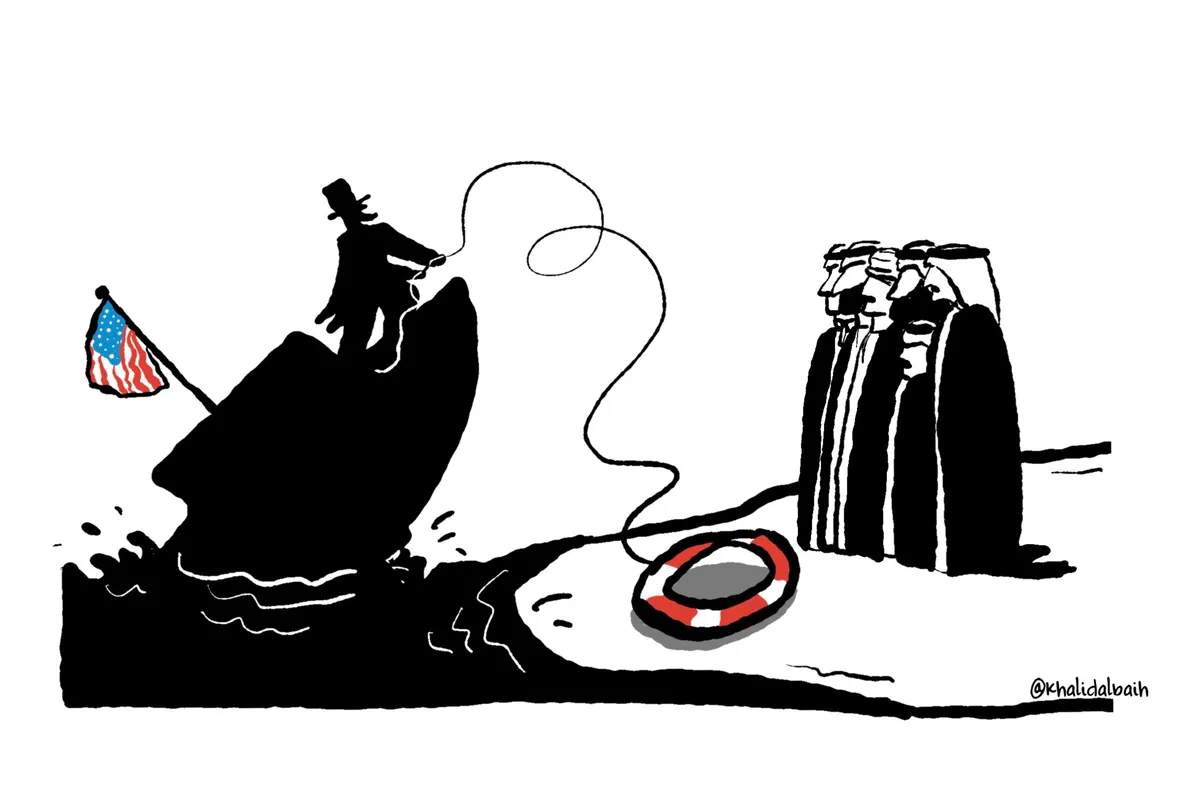
Why can’t Saudi Arabia, one of the world’s biggest military spenders, stop the Houthis? The answer isn’t weapons. It’s the bargain the Gulf monarchies were built on, which is now breaking, and a decade of MBS’s absolute power that left the kingdom no way out.
Published 22 October 2026Saudi Arabia is one of the world’s biggest military spenders, yet this month, as Houthi missiles shut Riyadh’s main airport, it cannot reliably secure its own territory. Why? Weapons, drones, doctrine and alliances all matter, but the real answer goes deeper than air defences, training or generals. It goes to the kind of state Saudi Arabia is: why this military was built this way, why the kingdom can’t simply fight its way out, and why that threatens the Gulf’s future.
This is about the Houthis and MBS, but it doesn't end there. A model of statehood that sustained the Gulf monarchies for generations is under existential pressure. The crisis is happening now, before our eyes, and its roots go back much further than this war.
Saudi Arabia makes the clearest case. Its decade under MBS was unusually dramatic, and it had perhaps the Gulf's greatest chance to change course. To understand what went wrong, we have to understand two bargains that made this whole political order possible.
The two bargains that built the Gulf
The Gulf rentier model rests on two bargains. One is internal, between ruler and citizen; the other is external, between the state and the hegemonic power that protects it. They reinforce each other. Today both are shaking, and that is the heart of the crisis.
In a rentier state, the state gets much of its income from external rents, chiefly oil, instead of taxing its people. Money arrives in the ruler's hands first, then flows into society. That reversal shapes political power as profoundly as it shapes the economy. Under the domestic bargain, citizens get jobs, benefits, infrastructure, prosperity and a share of the oil wealth. In return they surrender political agency. The ruler decides the national future; citizens are expected to be loyal, grateful and quiet.
Over generations, this shapes what citizenship means. The citizen becomes a beneficiary of the state, rather than a participant in creating and governing it. And part of what the state promises to provide is security, including protection from the demands of prolonged war. Gulf soldiers do serve, fight and die. This is no judgment about their patriotism. But a model built around providing comfort and security cannot easily demand years of mass mobilisation and heavy casualties without endangering the bargain on which its legitimacy rests.
This is not an argument about dictatorships in general. Authoritarian Egypt built a mass conscript army. Iraq was oil-rich and authoritarian but had a very different state-society relationship. The particular Gulf rentier bargain is what matters here. It also helps explain restricted citizenship. Migrants sustain Gulf economies, but rarely enter the political community receiving the oil dividend. In the smaller monarchies especially, limiting the citizen population keeps that bargain affordable and the hierarchy intact.
The external bargain follows from the domestic one: if the ruler promises security while avoiding the political costs of a mass national army, someone else must carry much of the burden. For decades, that someone was the US-led regional order and its immense military power. But the Gulf rulers didn't merely sit under an American umbrella. They cultivated influence inside the protector's system: immense arms purchases, investment pledges, lucrative contracts, elite access and sometimes relationships that look a lot like political "bribes".
Hence the paradox: buying an expensive American weapons system may strengthen your defences, but it also purchases attention in Washington. Procurement becomes political insurance. What serves the alliance, however, isn't necessarily what builds an effective national army. This is why Saudi Arabia could buy world-class hardware without building an army capable of sustaining a vast, bloody ground war. Its defence model relied on imported systems and external backing, rather than organising society for long-term national mobilisation.
The bargains lock together: external protection lets rulers avoid renegotiating citizenship, and the domestic bargain makes that protection indispensable. Take away the protector, and the problem stops being merely military. It becomes a question of what the state must be.
The Arab Spring's unanswered question
This model was already facing a historic challenge before MBS. In 2011, the Arab Spring asked a question rulers hated: who owns the country? The ruler who distributes benefits, or the citizens whose lives and futures are at stake? Across the region, people demanded political agency, and they were shot, tortured, jailed and killed for it. Their revolt challenged the social contract itself: the idea that national destiny belonged to rulers and ordinary people existed to receive their decisions.
Saudi Arabia had its own, quieter opening. Its young, educated population built an extraordinarily lively public sphere, particularly on Twitter. Reformists often asked for modest things: information, accountability, local participation, space to criticise policy. At the same time, everyone could see that the old oil-dependent economic bargain was becoming unsustainable. The kingdom had the money, talent, scale and young population to attempt a serious transformation. The open question was what sort of citizen that transformation would create.
Two answers competed. The Arab Spring answer was greater public ownership of the future; the counterrevolutionary answer was transformation granted from above, with the ruler keeping all political power. MBS would become the most ambitious expression of the second.
MBS's counterrevolutionary answer
MBS offered a complete answer to that historical question. He would transform Saudi Arabia, make it prosperous and powerful, and give people new freedoms. But he would not share political power. In fact, he needed more of it to make the transformation happen.
His diagnosis was compelling. Oil dependence and the old Saudi economic bargain were unsustainable, and MBS said so with an urgency rarely heard from an Arab ruler. He was right that the country needed a fundamental change. What he actually chose was a package: absolute personal power; a silenced public sphere; economic transformation through Vision 2030; social liberalisation from above; confrontation with Iran; and a new regional future built with the UAE, Israel and Trump's Washington.
First he seized the state. MBS displaced Mohammed bin Nayef, broke older balances within the royal family and gathered economic and security power into his own hands. The Ritz-Carlton "anti-corruption" purge crushed rival centres of wealth and influence. The justification was that reform was too urgent to tolerate obstruction, so dissenting economists, writers, clerics and activists were treated as threats. Even potential allies in reform had to be silenced: there could be only one author of the national future.
Saudi women gained the right to drive, but the women who campaigned for it were punished. That public sphere was crushed; Jamal Khashoggi was murdered in 2018. Social freedoms could be granted from above. Political agency could not be exercised from below.
Abroad, he began with war. In 2015 MBS launched the intervention in Yemen, expecting to defeat the Houthis and contain Iran. It was meant to demonstrate a new, decisive Saudi Arabia. Instead it created a war the kingdom could not finish or walk away from.
This was part of a confrontational security doctrine. In 2017 he spoke of taking the battle into Iran rather than letting it reach Saudi Arabia. He believed Saudi power could be secured through bold moves, decisive allies and an anti-Iran regional order. That order had an Israeli blueprint. Before Trump took office, Netanyahu and his circle promoted a Gulf-Israel alignment against Iran, with Palestine subordinated to the arrangement. The UAE's Mohammed bin Zayed was already receptive.
Jared Kushner became a bridge between MBS and Trump's White House, with the UAE playing a major role. My reading is that this network materially assisted MBS's rise and consolidation, while drawing him into an Israeli-favoured vision of the region's future. That future meant normalisation, an anti-Iran bloc and pushing Palestine aside. Many of the Saudi voices MBS suppressed would have opposed it fiercely. I don't believe the silencing of those voices and the regional project were unrelated. There is much more here.
Even the economic map overlapped: NEOM at the meeting point of Saudi Arabia, Egypt, Jordan and Israel; Tiran and Sanafir; Trump's "Deal of the Century"; dreams of regional integration. MBS imagined his country's future inside this new order.
At home, Vision 2030 promised a genuinely post-oil economy. MBS poured money into megaprojects, from NEOM and The Line to the Cube, alongside other sectors. But the test was never how futuristic the renderings looked; it was whether oil dependence ended.
Social restrictions were loosened, bringing Saudi life closer to freedoms already ordinary in much of the Gulf. But everything remained a concession from the ruler. The economy could change, lifestyles could change; the citizen's political status could not.
The Economist asked MBS in 2016 whether economic change required a new social contract and political representation. "One thing is not related to the other," he replied. The government already represented the people. Khashoggi, who supported reform, asked a different question: we know what the government wants, but what do citizens want? His 2016 series called for information and local participation. MBS wanted new duties from citizens, without new political rights.
The price of absolute power
A ruler who tries to transform an entire country while destroying the people and institutions capable of challenging his judgment produces more than repression and injustice. The country progressively loses its ability to learn.
Transformation needs feedback: experts who can say "this won't work", citizens who can object, institutions that can correct course. MBS rewarded obedience and manufactured consensus. He gained the power to make decisions, but weakened the capacity to make good ones.
The spectacle was one result: NEOM, The Line, the Cube, vast sums and fantastical projections, followed by retrenchment. The kingdom has spent $64 billion on NEOM alone, and NEOM's budget to 2030 sets aside $16 billion just to cancel contracts there. Imagine what Saudi Arabia could have built with even a fraction of that money invested in its people and productive institutions.
Yes, some sectors expanded. But the promise wasn't "more things to do with oil money"; it was an economy that could survive beyond oil. A decade and enormous expenditure later, that dependency remains: oil still supplied 55 per cent of government revenue in the first half of 2026. You can pump out water and still be drowning.
Foreign policy ran up its own bill. Yemen strengthened the threat it was meant to defeat, and the anti-Iran strategy brought no durable security. Between 2021 and 2023 MBS sought accommodation with Iran and the Houthis to protect his economic plans. Sensible, perhaps, but precarious.
None of the underlying danger was unforeseeable. Jane Kinninmont, then at Chatham House, warned in 2017 against deferring political reform until crisis forced it. We made related arguments then too, in the first episodes of the Arab Tyrant Manual podcast. The true cost was the lost decade of national capacity. And now the crisis has arrived.
2026: when the bargains break
Since 7 October, Israel's wars have escalated into the 2026 Iran war. Saudi Arabia's security and economic future are being reshaped by decisions its rulers do not control. This is where the two bargains collide.
Pro-Israel networks helped MBS consolidate power, and he planned a Saudi future within their regional project. Now Israel's post-7 October wars have helped unravel the security environment on which that very future depended.
The US-led order hasn't disappeared, and it can still wage devastating wars. But it is becoming less reliable as a protector, even while its actions expose Gulf states to retaliation. The power that was supposed to guarantee their security can itself generate insecurity.
In 2018 Trump displayed a chart of Saudi weapons purchases alongside MBS. The purchases bought hardware and influence. Yet after years of contracts and elite cultivation, Riyadh cannot stop Washington and Israel pursuing a war that endangers Saudi Arabia. Worse, the next escalation may follow electoral calendars in Israel and the US, not Gulf interests. Gulf rulers may pay the price without any say in the timing. Even the political influence they paid for is failing.
Vision 2030 needs stability, investors, tourism and predictable trade routes. Instead the Gulf and Red Sea are threatened, infrastructure is exposed, and another crisis can erase years of economic work. MBS's promised future depends on a peace he cannot guarantee.
Then there's Yemen. MBS entered the war in 2015 to neutralise the Houthis. Eleven years later they are a formidable regional force, with capabilities and grievances expanded by the conflict. Saudi Arabia cannot relocate the border or erase what happened. The asymmetry is savage: cheap missiles and drones can threaten airports, oil infrastructure, ports and investment. The Houthis don't have to conquer Saudi territory to make its security promise untenable. They need only keep the country exposed and unpredictable.
Riyadh's apparent options are to ask Washington to save it, assemble new allies, make another deal with the Houthis, or send the Saudi army into Yemen. Every apparent way out reveals another problem, and each leads back to how this state was built.
Washington can sell interceptors or send forces, but it cannot be relied upon to resolve Saudi Arabia's Yemen problem on Saudi terms. And its own Iran war may keep the Houthis mobilised. The external protector is part of the predicament, not an escape from it.
So began the search for alternatives: the Mecca Pact signed with Turkey and Pakistan in August, and ties with Egypt. These relationships may yield diplomacy, intelligence, equipment or deterrence. But a pact on paper is not an army willing to fight for years in the mountains of northern Yemen. The "kafeel mentality", named for the sponsor who holds a migrant worker's residency in the Gulf, has reached its limit. Saudi money can cultivate partners, but Egypt, Turkey and Pakistan have their own interests, publics and political risks. None can simply be hired to absorb the casualties of a Saudi war. Alliances aren't mercenary armies.
Then there is negotiation, which Riyadh was already trying before 7 October. But the Houthis and Iran now have stakes in a much wider war, with reasons to escalate independent of Saudi calculations. Accommodation may remain necessary, yet far harder to secure.
That leaves the Saudi army. A serious campaign into Houthi heartlands would mean years of fighting, heavy casualties and no assured victory. The issue isn't whether Saudis can fight. It's whether this political order can sustain the kind of war its security crisis demands.
This is why buying modern weapons didn't solve the problem. The external security bargain reduced the pressure to build a mass-mobilising national state, and Saudi Arabia acquired formidable equipment within a system that kept political agency concentrated at the top. Building autonomous national defence at that scale means changing the relationship between state and citizen: service, recruitment, taxes, sacrifice, and shared responsibility for national survival. Those demands cannot be reduced to another arms contract.
A dictatorship can conscript people, of course. But this rentier bargain promised security in return for quietism. Asking citizens to send their children to die in a prolonged war while denying them any political say is a fundamental rupture: blood without representation.
This is the trap. Lose reliable external protection, and you need a different national defence model. Build that model, and you must renegotiate citizenship and political obligation. Do that seriously, and you challenge the foundations of the regime itself.
MBS's legitimacy is tied to Vision 2030, and that vision needs security. His alliances can't guarantee it, his army can't impose it, and his political model constrains the national mobilisation needed to defend it. The pieces of his project now undermine each other.
Zoom out, and this isn't just a Saudi military failure or an MBS disaster. External protection sustained the Gulf's domestic bargain for generations. As the US-led order falters as guarantor, the whole model of Gulf rentier statehood faces existential pressure.
The future they cannot buy
Each Gulf state has its own history, but none can buy a new social contract. If external protection fails, rulers must confront the political agency they've spent generations avoiding, which is a far bigger change than buying more weapons. Saudi Arabia may have had the best chance: wealth, territory, a large young citizen population and a real prospect of renewal. MBS recognised the need for transformation, then spent a decade destroying the independent political capacities that might have achieved it.
The window Kinninmont warned about in 2017 is now narrowing in the worst possible conditions. I don't think most of the region's present rulers have the judgment or courage to navigate this transformation. There is no satisfaction in having seen part of this coming. Think of the years lost, Khashoggi and the others destroyed, the public sphere extinguished, the money wasted. The deepest cost of tyranny is often the future that never gets a chance to exist.
It all goes back to the Arab Spring. Its central question was: who owns our countries' futures? MBS offered the counterrevolutionary answer: a ruler can deliver national renewal without political rights. Look where that answer has led.
This piece opens several doors. Next we will cover the Iran war and the post-US regional order, Yemen, Israel, the UAE, and what comes after this Gulf model. Follow, share and support Kulna if you want to explore them with us.