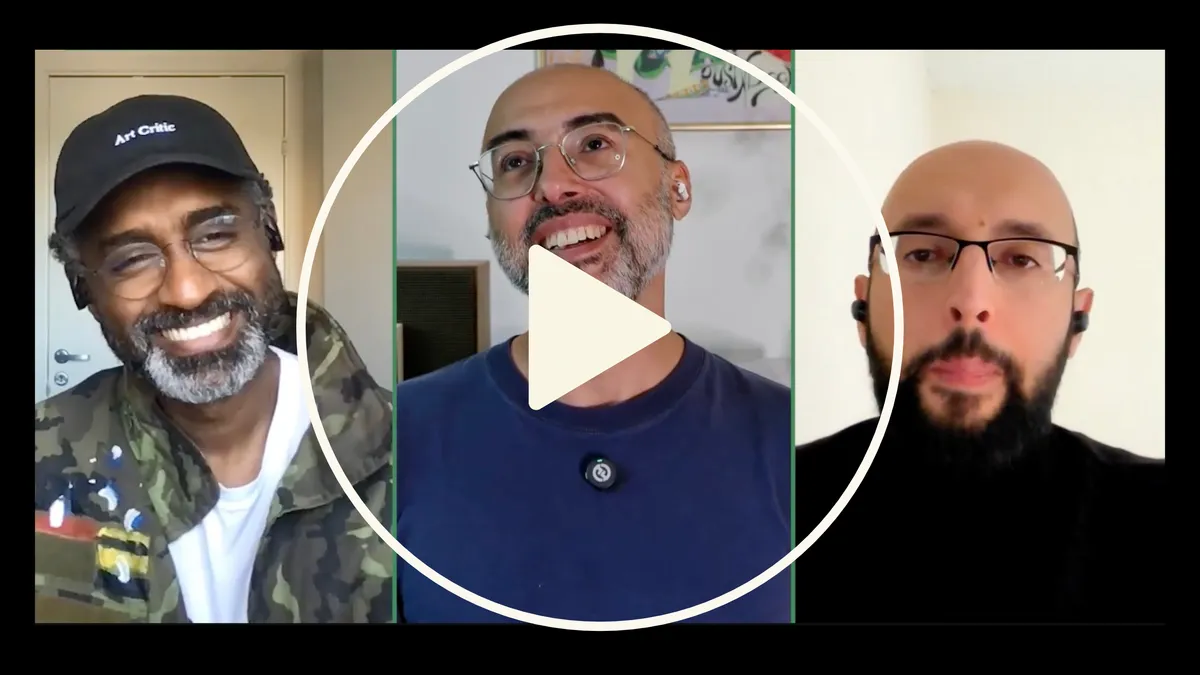
Introducing How to Liberate
In our inaugural episode, the team behind How to Liberate introduce themselves, the podcast, and how it will see the world.
Published 22 September 2026Chapters
- 00:00 Cold open: grief, betrayal, and why Kulna exists
- 00:59 From Arab Tyrant Manual to How to Liberate
- 02:16 Welcoming Iyad el-Baghdadi and Khaled al-Baih
- 03:12 What Kawakibi is, what Kulna is, what this podcast is
- 06:47 Khaled's story: born in Romania, raised between Sudan and Doha
- 10:13 Political cartoons, Naji al-Ali, and finding a voice through art
- 14:07 The internet, the Arab Spring, and what came after
- 16:30 Iyad's parallel story: Palestinian refugee roots
- 24:05 Disillusionment before 2011: Oslo and the "end of history"
- 26:00 2011: from a "startup guy" to the Arab Spring, online
- 32:16 October 7th, personal grief, and the birth of Kulna
- 34:55 Why "How to Liberate": between news and commentary
- 37:25 Applying the systems-change lens to Sudan
- 39:52 Sudan's revolutionary history, from 2011 to the 2019 uprising
- 45:12 How Hemedti and the RSF were built by the state they now fight
- 53:04 A war as punishment: Sudan's isolation and the wider region
- 59:54 Libya: power concentrated and legitimized from outside
- 1:01:17 The UAE's hand in Libya, Sudan, and Palestine
- 1:08:12 No clean heroes: moral clarity in a complicated fight
- 1:12:16 System change and collective liberation
- 1:13:34 Outro: what's coming next, and what Kulna is
Transcript
IYAD: From that extreme grief, extreme betrayal, and extreme moral clarity of October 7th — and everything that happened after it — came the platform we bring you today: Kulna. Kulna is Arabic for "all of us," and that's the point, all of us, because we believe so much in collective liberation. Our personal journeys show that the only way to liberate is to liberate together. The Sudanese people are not going to be liberated in isolation. The Palestinian people are not going to be liberated in isolation. The Libyan people are not going to be liberated in isolation. It's all of us or none of us — this is a collective struggle. Kulna is about elevating and continuing conversations about collective liberation through the lens of system change, because if you just knock down a dictator or a bad regime without changing the system, you're going to get the same system creeping back in another form.
AHMED: Welcome to How to Liberate. I'm Ahmed Gatnash. If you've been following this feed for a while, you knew it as the Arab Tyrant Manual podcast. The old show was about authoritarian regimes in our region and how they actually operate. The name was tongue-in-cheek, but it came out of a frustration with how the news covered 2011 and everything that came after — and one question in particular: why do the same tactics keep turning up in country after country, under regimes that have almost nothing else in common? The question has an answer, and that answer is what this show is now about. The tactics belong to a system rather than a particular ruler, which is why removing a dictator so often changes so little. So we're now asking how power gets built, how it gets made to look legitimate, and what it takes to replace the system rather than the man sitting on top of it.
I'm joined for this one by Iyad el-Baghdadi, who co-founded the Kawakibi Foundation and who many of you know from the Arab Tyrant Manual podcast, and Khaled al-Baih, the Sudanese cartoonist whose work ended up on walls across the region in 2011. They discuss where we came from and how we understand our work. Think of it as an intro to the relaunch of the podcast.
AHMED: Welcome back to the How to Liberate podcast. This is our very first episode under the new name and branding, and I'm joined today by two very special guests — and by "very special guests," what I mean is people I work with every day. Welcome.
AHMED: Let's start with where we've come from and where we're going with this. Why is it the How to Liberate podcast now, instead of the Arab Tyrant Manual?
IYAD: Yeah, it's a good place to start, and an exciting one — I'm happy to be starting it with you guys. Khaled, your setup is really good, with the military-style jacket and the cap — amazing. For people who don't know us and haven't followed us, maybe this is a good place to start by introducing who we are and what this podcast — what this media initiative — is.
So, my name is Iyad el-Baghdadi, and a bit later in this episode we'll talk more about my journey. But I think it's important to start with what Kawakibi is — the organization behind this podcast. Our personal stories converge on 2011, the Arab Spring uprisings. That was a formative moment for all of us — myself, Khaled, Ahmed, and the rest of the team. Not that we were all involved in the same events, but it was a formative moment. After 2011 there was this flowering of free speech, free expression, and democracy activism across a lot of the Middle East, and we found our voice — whether it was Khaled making cartoons that went viral and ended up graffitied all over the place in different Arab countries, or me finding my voice online, on Twitter and other social media, or Ahmed, who was still a teenager at the time. The entire region found its voice. But it was a brief moment, and after that the tide turned against our movement, and we found ourselves in exile. A lot of us never made it out — there are comrades who didn't have the chance, some who died, some who are in prison, some who are still recovering, a decade later, from what happened. But we were fortunate enough to find ourselves in exile. We tumbled for a bit, but we landed on our feet. From exile — I'm speaking to you today from Oslo, Norway — we started to form a community again, to find each other and start working together, and that became the core of the Kawakibi Foundation. There are many faces in the foundation, ten members right now — you're seeing a subset of the group, but in due time you'll see all of our faces.
It was only a couple of years ago that we decided we wanted to turn our activism outward by creating a media platform. Over a lot of time we've accumulated a lot of expertise, a lot of memories, a lot of knowledge — we've been doing this work for a very long time, and we're deeply integrated into networks, whether it's me with the Palestine movement, Khaled with the Sudan movement or the art world, or Ahmed and the rest of the team. So we come into this with a lot of knowledge, a lot of talent, and we thought it only appropriate that as we enter this new field of independent media, we have our own public voice.
So Kulna is the name of our new media platform, representing these voices and bringing together a lot of voices from our networks as well. That's what Kawakibi is, that's what Kulna is — Kawakibi is the name of the organization, the home; Kulna is the name of the platform. And this podcast in particular is called How to Liberate. The How to Liberate podcast.
AHMED: Khaled, you'd mentioned your cartoons ending up graffitied on walls in countries you'd never set foot in. I want to come back to that, but first let's go earlier. You're Sudanese and you grew up almost entirely outside of Sudan. How did that happen?
KHALED: Yeah, so — I'm Khaled, which in Sudanese means "son." I'm from Sudan, but I was born in Romania — my father was a diplomat. We lived in Sudan until, I think, the early '90s. This wasn't the very start of Sudan's brain drain, but I'd say it started from the mid-'80s — a lot of professors, engineers, doctors, a lot of Sudanese people left Sudan around that time, whether for political pressure or for financial reasons. My dad, at some point, gave up and said, "All right, we're going to continue this journey from abroad." We ended up in Doha, Qatar, and I grew up in Doha for most of my life.
Doha was very interesting for me because I met people from everywhere. In Sudan, most people were Sudanese — different tribes, different ethnicities, different languages, but mostly everybody was Sudanese and spoke Arabic. When I went to Doha, I was in a class with, I don't know, twenty nationalities. That gave me a view of the world that a kid who doesn't yet understand why he had to leave home — what is politics, what does it mean to be a dictator, what does it mean to stay home and risk it, what does it mean to go abroad and also risk something — doesn't usually get. It was incredibly interesting growing up. Even within the Arab world you still grow up different, because at the end of the day you're not home. But that gave me a lot of perspective on regional politics, because I was interested in it, and because I saw what my parents were interested in. At the same time, I was very interested in art — I was into comics, reading a lot of comics. That's where the journey started, really — I used to draw the whole time, trying to make sense of what was going on around me.
As a teenager, my father started buying political cartoon magazines — one Egyptian one called Sabah [publication name unconfirmed — see notes], the other called Rose al-Youssef — prestigious, hundred-year-old magazines, both built mainly on cartooning. For me to discover that art could be used that way — to ask questions, to criticize, to bring people together, and combined with satire — that was a whole other powerful combination. So I started doing it in school, copying all the art I found in the magazines, trying to make sense of the politics through the articles.
I discovered a lot of really interesting artists, some who gave their life for what they believed in — Naji al-Ali, for example. I started copying Naji's work, because he mixed art with poetry — he worked with the poet Ahmad Matar [name unconfirmed — see notes]; both of them were in Kuwait, and later in London. It was a whole new world for me — that was my way of finding questions, my way of talking about politics, because as a diasporic kid you're always taught to be careful who you talk to, how you talk about politics, who you talk to about politics, what your politics even are. It was a very interesting time as a teenager, trying to connect the dots between art, politics, and being a third-culture kid. I started drawing cartoons of the teachers in school — the teachers hated it, the students loved it, so I figured I was doing a good job.
After that I was lucky enough to study something I was interested in — design — and to work in museums, which opened my eyes to the history of the region and the fact that this didn't start now, didn't start with the rulers we've seen ruling the region for twenty, thirty years. It didn't start with them. And how art was also involved in bringing this region together — especially for Sudan, which is a meeting point between the Arabic-speaking world and sub-Saharan Africa.
Around the same time, the internet started happening, and that's where I started meeting other artists, publishing my work, and all of us finally found a free space to work — which I think was one of the reasons that led to what became known as the Arab Spring. By that time I'd found my own character, from copying Naji al-Ali up to that point. It was an amazing time — it showed us that with solidarity, with collective liberation, and thinking about different ways of creating possibilities and inclusion, and working on rights — just simple things, really, talking about them openly, discussing them openly — it was incredible. And of course it was met with a lot of violence for exactly those outcomes.
We're still living the outcomes of what happened during those times. I read somewhere that someone asked Stalin what he thought about the French Revolution, and he said, "We will see." That shows how long it takes for things to actually happen. The Arab Spring was, of course, the start of something — all that accumulated history led to that moment, and we're still living it now. The weapons are changing, the ways of surveillance are changing, everything is changing — including the internet, the thing that brought us on and is now kicking us off. And I guess this is how we all ended up together — trying to figure out how we can talk to each other, and think collectively about inclusive solutions.
IYAD: Khaled, while you were speaking, there were multiple intersections between your story and mine. For example, I grew up with one of our closest family friends — a man I'd call "uncle" — a Palestinian artist named Abdul Karim Sayyad, who was friends with Naji al-Ali.
KHALED: Wow.
IYAD: And who was devastated — I remember the moment Naji al-Ali was killed, and it was devastating for us, because it was the same year as the intifada. There's another intersection — you studied design, and you actually studied at a university in Doha which is, what, ten minutes' drive from where I lived.
KHALED: Yeah.
IYAD: We actually lived very close by, without knowing each other, until we got to know each other after 2011 —
KHALED: — online.
IYAD: Yeah. (The next few lines are rapid cross-talk between Iyad and Khaled — exact attribution uncertain; verify against the recording.) But also — the thing you said about the quote from Stalin — I'm not sure if it's — I remember something like that too. "What do you think about the French Revolution? We'll see — it's only been two hundred years." Yeah, exactly. This is something I've been saying publicly and privately for a long time — when people asked me if the Arab Spring failed, I'd say ask me again in 2041. Ask me again when it's thirty years on, then we can see.
IYAD: Maybe this is an opportunity for me to also introduce myself and my background, because it's a very beautiful introduction you gave, Khaled, and it becomes very clear what you're bringing to this platform. We are different — the ten of us on this team come from different backgrounds and have different interests, and what makes this platform what it is is really the synergy between people who are different but share the same values and goals.
So my name is Iyad el-Baghdadi. I'm a Palestinian, child of Palestinian refugees. My father was born in Jaffa, Palestine — he was maybe four months old when the Nakba happened. His side of the family ended up as refugees in Egypt — because they lived in Jaffa, they had access to boats, and a small number of refugees left in 1948 and went directly by boat to Egypt. My mother's family is also from Jaffa, but they fled the Nakba in a different direction, to Damascus — so my mother was actually born in Damascus, and from there they moved on to Jordan.
This was a time in Middle East history when Gulf oil wealth was starting to rise, and those ancient, civilizationally deep centers of Arab culture — Egypt, Damascus, Baghdad — were being overtaken by this new Gulf wealth. Parts of the Gulf, for instance — you mentioned Naji al-Ali was in Kuwait for a while with the Iraqi poet Matar —
KHALED: The whole PLO was in Kuwait.
IYAD: Exactly. A lot of the Palestinian movement was there too, so it's not by accident that my mother was born there, and a lot of Palestinians were there — it's also that there was a margin of free speech available in those countries early on. The civilizational centers of the region, after colonialism rolled away, kind of succumbed to military dictatorship, so it was more oppressive to be there. My father graduated as a doctor from Egypt and had a choice between a job in Libya or one in the United Arab Emirates. If he'd taken the Libya job, Ahmed, I'd be much closer to your timeline, since you're Libyan. But he took the UAE job, in a place he didn't know, which is where Khaled eventually went to university. So I was born in the Gulf — and just like Khaled said, growing up in a very multicultural society, in a classroom with kids from so many different nationalities. If you grow up in Syria, or Egypt, or Sudan, you don't actually meet a lot of other Arabs — mostly just your own nationality. There was something very positive about meeting not only different Arabs but different nationalities generally.
Because I grew up Palestinian, and I was only ten years old when the first intifada happened, in 1987 — and because the Palestinian community in the UAE was closely knit, especially in Sharjah and Ajman [place names unconfirmed — see notes] — people knew each other, and political discussions came up constantly whenever adults got together, talking about the news. When you're young you already take that in — the conversation is always about the news, and Palestinians are very politicized people, because there's even a song comparing the radio, for Palestinians, to opium — "Radio, oh opium" [lyric paraphrased from memory of the speaker; exact wording unconfirmed] — because you're addicted to the news, you want to know what happens next. You're from a people very much impacted by what happens in politics, because it's not politics — it's what's happening to your family, your parents, your grandparents, your kids.
So I grew up politicized, in other words — there wasn't a moment where I "discovered" politics, it was always part of the conversation, part of our upbringing. I remember the moment of Naji al-Ali's assassination, because we grew up around people who knew him and worked with him, artists and so on — it was a painful moment. Handala, for example, which is now a very well-known symbol, is Naji al-Ali's creation — symbolizing himself, actually — the little kid who's just standing, watching what's happening. He left the refugee camp at ten years old, and —
KHALED: Alhamdulillah, supposed to be forever ten years old.
IYAD: Yes, forever ten years old. But yeah — so I went through my own process of disillusionment long before the Arab Spring. In the 1990s there were the Oslo Accords, the Oslo peace process. It was a series of events — in 1991 you had the collapse of the Soviet Union, and the United States becomes the only superpower, and as a Palestinian I grew up knowing that the power supporting our oppressors was the United States. We grew up in a region that is — and this isn't a surprise to anyone — one of the most anti-American regions, given the support the US had given our dictators, our oppressors, for such a long time. So there was this process of disillusionment where you have the Oslo Accords, and me clashing with my dad, because my dad was saying, "Let's get what we can — if they're going to give us a state, let's get what we can."
Meanwhile I'm saying, "No, but this is so unfair. I know the history of my people, the history of my family, I know where you were born." After that period, you got sucked into — as you mentioned — the internet, coming up in the late 1990s, this "end of history" moment. You're growing up, getting introduced to this world, and it's easy to drift away from politics and become disillusioned. I still had the same political values, but I became the startup guy — you went into art, I went into startups, tech. There's still an intersection, because I was also very interested in cartoons — in my twenties I actually founded a cartoon workshop; I'm not the person drawing the cartoons, but I like working with people who do.
Then 2011 happened, and 2011 was this moment where — I could easily have continued on my path, I wasn't on a political path, I don't think most of us were. But suddenly you're looking in the mirror and thinking, I know this is a historical moment, I know this is going to shape everything that comes after it. If you sit this one out and say, "It's not my business, I don't want to get involved," you'll have real trouble explaining that to yourself, or to your children, later on. I was 33 years old, and I remember actually looking in a mirror and thinking, this is the moment, this is it. From a young age I'd been told, and had seen, repeatedly, how illegitimate this political order is — the imperial order, the regional order, Zionism, imperialism, colonialism, Arab dictatorship — there's this sense of illegitimacy, that this is not a legitimate order and it's wrong. And suddenly you have people all across the region, in the streets, taking bullets to the chest to say: the people demand the downfall of the system.
KHALED: Yeah.
IYAD: It was such a refreshing moment — a moment of courage and pride and pain, because you could see people getting shot in the streets, and you could see it was the same statement everywhere — of course we have to say Sudan, Libya, Morocco, Jordan, Iraq, they're different countries with different histories, their own local contexts, different regimes, power built differently — but everybody across the region was saying the same slogan: the people demand the downfall of the system.
I went online, and very quickly found an audience — curiously, that was when Ahmed started following me; he was watching the Libyan revolution, and I'd become very interested in it too. Ahmed was, I think, 18 or 19 at the time. Initially I was just excited about following the revolutions, translating news for a non-Arabic audience. But very quickly I started asking: what's next? What happens when the dictators are gone — are we really okay, or is this at risk of everything reversing, because we don't have a plan for what happens after dictatorship? A thousand questions that had always been frozen were suddenly very urgent. People had been reading books about democracy, about socialism, about economic systems, their whole lives — but it was frozen, because politics didn't really exist as a live question in our part of the world. Suddenly it became urgent — we needed to find solutions now, and if we didn't, the remnants of the old regimes were more than willing to brush us away, kill everybody, take back control.
KHALED: Yeah — sometimes with the West as well.
IYAD: Absolutely. That's what happened — the first revolution to be betrayed was the Bahraini revolution, with the explicit support of the West. It was very clear that Western countries, led by the United States, did not want this democratic transition to happen. They wanted to divide us — to say some revolutions deserve support because they serve their geopolitical interest, and others are inconvenient and should be suppressed. That's part of the wound we carry, because when we speak, we're speaking from our own experience, our own place — and a lot of commentary, and maybe this is why this podcast and platforms like it matter, isn't from people who lived through these things, it's from people watching from across the world. A lot of the commentary about these events came from people not involved in them. With all my respect and admiration for a lot of American, British, and other independent media, a lot of them comment on our region without being from the region.
KHALED: Yeah.
IYAD: And a lot of them have good values, but it's difficult to apply those values to a local context, and a lot of the time they don't get it right. This is where my interest in systems change came from — that for us to actually reach liberation, we need to be very good, very shrewd, at systems change. That's what I bring — along with my Palestinian background, which is basically everything I grew up around. For many years, before October 7th, I was a voice that spoke not only about Palestine — I was known as an Arab Spring activist, speaking about Syria, Libya, Sudan, Egypt; I was involved, for example, in the Jamal Khashoggi case and the democracy movements around it. October 7th, though, was a moment where I swung directly back to where I started — Palestine. That process really started with the Sheikh Jarrah protests in 2021 [event named uncertain — see notes], the killing of Shireen Abu Akleh [name uncertain — see notes], events that in a sense predicted what came in 2023 before the genocide started. But October 7th was the moment of truth and rupture.
There were many events in my life that made me much more radical — the Syrian uprising, the Khashoggi assassination, Biden shaking hands with Mohammed bin Salman afterward. Every time you think, maybe there's a way to accomplish change within the system, you're reminded: no, the system is built that way, it isn't going to reform, it has to be replaced. October 7th was the final blow, and it was an extremely painful moment for me personally, as a Palestinian — and also because of what was happening in my own life. I'd had my own personal journey with my family after 2011, after my exile, but my father passed away shortly after October 7th, a few months after. There was a lot of grief — grief, and a feeling of moral betrayal, actual betrayal, by a lot of people who you thought shared your values. It was a formative moment for what came after.
From that extreme grief, extreme betrayal, and extreme moral clarity of October 7th, and everything that happened after, came the platform we bring you today: Kulna — Arabic for "all of us." That's the point — all of us — because we believe so much in collective liberation, and our personal journeys show that the only way to liberate is to liberate together. The Sudanese people are not going to be liberated in isolation. The Palestinian people are not going to be liberated in isolation. The Libyan people are not going to be liberated in isolation. It's all of us or none of us — this is a collective struggle. Kulna is about elevating and continuing conversations about collective liberation through the lens of system change, because if you just knock down a dictator or a bad regime without changing the system, you're going to get the same system creeping back in another form.
So that's my story, and how I come to this. The Arab Tyrant Manual podcast emerged from that early commentary and analysis, from the beginning of the Arab Spring — trying to step back from day-to-day events to understand the bigger picture, why this is happening, what dynamics are driving it, why we keep seeing the same patterns unfold country after country, why authoritarianism seems to consistently choose the same tactics, the same strategies. That's why we tongue-in-cheek named it the Arab Tyrant Manual. And How to Liberate is another evolution from that. How to Liberate is not news and not commentary, but it has a lot of both. If you follow political podcasts, you'll see news podcasts always trying to be salient, always breaking news — telling you what today's news is — and then commentary podcasts, commenting on the news, giving you analysis. We're somewhere in the middle: we follow the news cycle and we do offer commentary, but we're coming from a very different place. We're very interested in power and liberation. When we take a situation — say, today's news has something about Trump, something about Sudan, something about Palestine — we want to decode it: how is power involved in creating this news, or driving it? How was it created, how is it legitimized, how is it resisted, how can it be replaced? We're taking a systems-change approach to the news, so we can help pull people from the extremely urgent conversation about what's happening today into a conversation about how we change the system. That's the premise of this podcast.
IYAD: Khaled, I'll hand it to you with this question — when you look at Sudan in the news of the day, where Sudan is in a civil war that has involved genocide, how do we apply this lens of system change, studying power, to go from the news to transformation?
KHALED: In the case of Sudan, I think it's mainly about understanding what's going on and discussing it, bringing it to the table, and connecting it to what else is going on — not only in the region but in the world, a bigger perspective — discussing whether it's really a civil war, or part of a change across the whole region, whether it's manufactured to not reflect how central Sudan was to a lot of things going on economically and politically. These are all discussions that put Sudan in a wider lens rather than just a headline — and, most importantly, connect it to what's going on, to different aspects of how we got here and where we're going from here, because that really is the main question — just like the question you asked, which no one answered after the Arab Spring, and that's how we ended up in the situation we're in today. How do we avoid, again, the killing of another change, another attempt — how can we do it differently? I think that's why this matters for Sudan.
AHMED: Let me ask you a question, because Sudan wasn't one of the 2011 countries that had a revolution —
KHALED: It was — it was just shut down.
AHMED: It was phased out very violently, like Algeria, I think, at the time. A lot of people died in 2011, a lot of people died in 2013.
AHMED: In 2011 there were 22 Arabic-speaking countries — let's call them that. Twenty of them had some major uprising or protest movement in 2011, and Sudan was one of them. However, Sudan didn't have a change of government — it didn't have a successful revolution in 2011. As you mentioned, it was shut down very violently, as it was in multiple other Arab countries too, with successive uprisings after that. But it was in 2019 that the thirty-some-year rule of a dictator ended. That was an important moment — I believe in 2018–2019 there was an uprising, almost a second wave, in Sudan, Jordan, and I think there were also protests in Egypt, Lebanon, and Iraq. Maybe you can speak to this, because the Sudanese people have overthrown many dictatorships before —
KHALED: Yeah.
AHMED: — and yet we keep coming back to the next dictatorship. Maybe this is very telling.
KHALED: Yeah. Sudan changed three dictators — we had three periods of democracy, and the last one didn't last very long, I think it was a year, and that was in '86. From '86 to '89, and then in '89 there was another coup, and it continued until 2019, with Omar al-Bashir at the head of it. In those years there was everything — from protests and popular movements to actual armed confrontation. There wasn't really a period where the Sudanese people didn't resist — the people themselves, unions, and so on — to the point that the regime had to shut down every aspect of it, including politicians active internationally; they'd shut them down, or bring them back in. And at the same time, they were working inside the country to brainwash a lot of people, and the economic situation didn't help, and with American sanctions and so on, they'd always play it as, "Oh, you're with the people asking for Sudan to be sanctioned? Because we're fighting imperialism." This is what the region as a whole is in — you either have a dictator approved by the Western powers, or you have someone who becomes a dictator because he's fighting imperialism, fighting the Western powers. You're stuck between a rock and a hard place, and that's what continued to happen in Sudan, and I think in the whole region — being called a traitor, because there's no room for duality in how things are looked at. You could be fighting imperialism and also be a bad person, right? And that's what's going on until today, with this war as well — the army is fighting for the sovereignty of the country, and against an almost entirely foreign-funded militia, but at the same time the army is responsible for creating that militia and supporting it into being this powerful, and allowing it to be this powerful.
AHMED: Can you explain a little bit the context, Khaled, because this is a very interesting point — you're talking about the Sudanese civil war, and the two factions, the RSF, the Rapid Support Forces, or the Janjaweed, who are like the rebel group, and then the Sudanese army — but you're telling us that actually one of them is the creation of the other.
KHALED: Yeah, absolutely. The Janjaweed started off as a tribal militia fighting the government. Then al-Bashir, as I explained, was able to co-opt a lot of the opposition by giving them a seat at the table, as they'd call it, and a lot of money. So Hemedti — the leader, who later became the leader of the Janjaweed after removing the previous tribal leader — became the head of that very small militia in Darfur, where they committed genocide with the support of the Bashir government at the time [government name unconfirmed — see notes] against a lot of the tribes there. And of course that was also used in the West to paint the picture of that war as Muslim against Christian, while both tribes were actually Muslim — but that's what worked for the media at the time, to villainize, and continue to villainize, Muslims.
He became part of the government with his militia, and they were co-opted even more, given more positions and more power. At some point he was nicknamed — Hemedti is a nickname, his name is Mohamed Hamdan Dagalo, and "Hemedti" is what his mother calls him, or whatever. Under al-Bashir his nickname became "Hemayti" — "my protection," which is what Bashir called him. This happened around 2011 — they had a different name at the time, I think, and were brought into different cities to take down the protests asking for change. Then they were co-opted even further, becoming al-Bashir's own personal bodyguards, then co-opted internationally, shipped out to fight the war in Yemen, on the side of the Saudis and Emiratis. That's where he accumulated more power, more wealth, and international support — I think this was in the mid-2010s — as, maybe, the next potential option in case anything happened in Sudan.
That's kind of where everything was heading. And with Yemen — while the Arab Spring revolutions that happened there were unfolding, the Houthis came out of nowhere, which wasn't in the equation. So they wanted to make sure they had everybody controlled, that they knew how the next move would go in case of any system shake-down in Sudan. So he was a big part of the very institution he's fighting today — he made his wealth, his money, his family is as corrupt as the next person in government at the time. So all his claims now are absolutely false, because he's part of that system. When the war started, they didn't even know why they were fighting — his brother has a very famous, almost comedic video clip where he's on top of his tank under a tree, saying, "Why are you fighting?" — because when the revolution happened in Sudan, everyone accepted this was going to change. Of course there was pressure from Trump about normalization — they were already meeting with the Israelis. Everything the people were asking for about democracy came second — the first thing was that you had to play the game.
I think the change in Sudan happened because the civilian interim government at the time — I don't think they even refused normalization with Israel, I think they just said we have to wait until we have a parliament, because that's what the revolution is for, that's the kind of revolution we're aiming for. And about a month — I can't remember the exact dates — after that, a coup happened, and the interim prime minister, Dr. Abdalla [Hamdok — name and title as spoken uncertain; see notes], was put under house arrest. Less than a year after that, the war happened between the army and —
AHMED: Al-Bashir was gone, but those militias were still there —
KHALED: And the reason they fought — the reason they fought again — is because they really couldn't stop the Sudanese people. People were in the street every single day. People didn't forget about the revolution, didn't forget about the people who died during it, didn't forget the thirty years of resistance. The resilience is why we have this war, really — I think that's one of the main reasons: Sudanese people did not stay silent. Everybody — men, women, older women — I'd never seen my aunt run in my life, and I saw her run in a protest. The protest was like a family event, everybody went out. It's incredible how long that continued, for three years. Even after Bashir was toppled, people stayed — they killed people in the sit-in, people still stayed, still came out. They shut down the internet, people still came out. It just continued — they brought a president, changed the president, this whole thing. I think the regional powers, as well as the army, tried to play the same game: first you get a military setup backed by an autocrat — or a technocrat, sorry — and from there you control the situation. The guy takes off the military suit, wears a suit, same story. And I think that's what didn't happen — and that's why this war happened.
AHMED: So in other words, this war was almost a punishment to the Sudanese people for not "behaving," for continually demanding change.
KHALED: Absolutely — basically, "let's destroy this country because this country really, really wants change." I remember it being really interesting when you mentioned Sudan was in a revolutionary phase for three years — constant protest, constant mobilization.
AHMED: But the one thing you mentioned that's very important for our analysis on How to Liberate is that the region — and the dictatorship in Sudan — isn't isolated. It's not just a dictatorship that exists in Sudan, it's part of a regional system of dictatorship. And that continued because, interestingly, the protesters in Sudan themselves were thinking, "we are learning from the failures of countries that had revolutions before us." One of the main slogans of the 2019 Sudanese uprising was, roughly, "either we win, or we end up like Egypt" [slogan as spoken uncertain — see notes] — they were already saying they didn't want to end up with a military dictatorship like Egypt's. I'm sure we'll come back and study the specifics of this in many future episodes, because there's so much to look at — the Israeli involvement, how Israel graduated, after 2011, from a system that oppresses Palestinians into a regional authoritarian order that wants to suppress change across the region and have its own allies suppressing any kind of change; the Gulf regimes, and how they complicated and helped push Sudan's democratic transition toward this tragic route of genocide and civil war.
KHALED: Yeah, none of us live behind walls — we're all connected, all in a situation where we need to understand the steps being taken to normalize all of this — the social media bots, the control of the media as a whole, new TV channels, plotting people against themselves. But what we have in Sudan is a very strong, I think, unionist movement — in the street, in the neighborhoods, among professionals — and I think that's what let the Sudanese people — it's horizontal, and that's why they couldn't really stop it.
AHMED: Horizontal power structures.
KHALED: Horizontal power structures. I read a couple of weeks ago that the manifesto of the Sudanese revolutionary unions is one of the most revolutionary texts ever written — it's incredible, something the world will look at decades from now. I'm not the best person to speak about it, but there were incredible people who gave their lives for this struggle. A lot of very young stars in this movement — they were one with the people, one with the street, and they really did their best to guide the revolution.
AHMED: The Sudanese people have also historically been among the most supportive of the Palestinian struggle, and Sudan has been historically very important for Palestinians. I look forward to doing a few episodes with you, Khaled, focusing on that — and also on the moment of betrayal Palestinians felt when normalization talks were going on during the revolution. I remember, honestly, pissing off a lot of Sudanese at the time by saying, when you can see who's playing in the background, if you allow this to continue, they're going to ruin this revolution. People were still in a revolutionary, mobilized mood, they didn't like me saying it — but unfortunately I believe I was right.
KHALED: You're definitely right. We were all talking about the same thing, but I think this is what really divides most of the — what happened in Syria, in Libya, the violence that followed, and in Yemen too, the violence that followed the revolution and the collapse of the system, scared a lot of people from wanting change, because it gave not only the dictators but the international powers — including Israel — that ultimatum: do you want security, or do you want revolution?
AHMED: It's almost as if the script writes itself: if you're faced with a revolution, create so much havoc, so much death, so much destruction, that people think twice before replacing you. And I'm sorry to put you on the spot, Ahmed [as speaker-labeled in source — see notes on this exchange], but this is where Libya comes very close, because Khaled was talking earlier about how the Sudanese people aren't isolated, and what occurred to me is that the Libyan people, for a very long time, were among the most isolated. Maybe you want to comment on that.
AHMED: It's really ironic, because — we started off explaining that we're looking at how power is formed, concentrated, legitimized, and resisted. My first reaction, reading those words in relation to Libya, is that it's not legitimized — what's happening in the country is nakedly illegitimate, and it's not being resisted very well either. But then I thought about how it was concentrated, and realized I was looking at the system in isolation when it's part of a larger system — because it was concentrated outside the country, with the complicity and collaboration of external powers, regional and European. Without that, the power centers in the country right now would never have concentrated in the first place. The legitimacy also happens externally, because the way they get their support is by depending on what they can offer, or threaten, to outside powers — whether that's scaring them with the Muslim Brotherhood, or the spectre of illegal migration, which you can use to threaten Europe into doing whatever you want, it seems.
I wanted to ask you to internationalize the analysis even further, given that with the three countries we're kind of representing in this discussion — Libya, Sudan, and Palestine — one of the common factors between all three is the involvement of the UAE, your former country of residence.
IYAD: We went into so many strands in this conversation, and I'm sure in coming episodes we'll really focus on some of them — we're doing kind of a flyover from 30,000 feet, but we'll come back to a lot of this. You're right — the United Arab Emirates, the country I grew up in, used to be, for a long time, a peaceful place; even the founder of the country, Sheikh Zayed, was called "the wise man of the Arabs" — the guy trying to negotiate, trying to make sure wars didn't happen. I remember, famously, that he actually offered Saddam asylum in the UAE, saying, "Instead of taking your country to ruin, let me give you asylum here, and let's have some kind of elections or transitional process in Iraq instead of ruining the country." This was in 2002–2003, before the Iraq war. He died in 2004, and the country wasn't the same after that — it took a dark turn, around the same time as the Arab Spring, and it's still a bit of a question mark; maybe in coming episodes we'll speak to Emirati analysts and experts about that period of change, because something shifted around, or probably shortly before, 2011. This country, which used to not be very loud on the international or even regional scale, suddenly became very aggressive, funding counterrevolutions, dictators, movements across the region.
KHALED: Genocide in Sudan.
IYAD: Genocide in Sudan, exactly. It started with Bahrain in 2011, where they were part of sending troops in to crush a native uprising. In 2012 and 2013 they started agitating in Egypt, funding a counterrevolutionary movement against the democracy that was starting there. They also had some involvement in the Syrian civil war. From there, we saw them really invest in Trump's first term — when Trump came to power, the UAE leadership actually met him even before Obama's term ended, before the inauguration. It was very clear they wanted to use their special relationship with the Trump administration to send the region back into a more familiar, more pliable shape — they knew a more democratic, more assertive region wasn't in their interest. I wrote about this several times, including in the New York Times and the Washington Post, about how the leaders of both the UAE and Saudi Arabia were hell-bent on making sure the Arabic-speaking region doesn't democratize and remains under their patronage and control.
Part of that same process was the normalization agreements with Israel — the Abraham Accords — presented as a civilizational, cultural, diplomatic breakthrough, but really security arrangements first and foremost. It's within that same context that the intervention in Sudan came, which later became genocide — the UAE, as you noted, Khaled, funding the RSF, the Janjaweed, who are committing these atrocities. They were also involved in the civil war in Libya, and continue to be. It's a country that really needs to be studied, analyzed, understood — and we'll be doing that extensively in coming episodes, not just what the UAE was and became, but its future, because with the Iran conflict the country finds itself in an existential bind, an existential threat, and the future is very uncertain. It's clear the Gulf leaderships are normally looked at as a bloc, but they're not — there are similarities, but different regimes, different people, different attitudes and outlooks. Qatar, for example, is right next to the UAE but couldn't be more different in outlook, in what it wants and how it approaches things.
KHALED: And that's why, when I try to explain the war in Sudan generally, I don't just mention the UAE — there are other involvements too, whether Turkey, Egypt, or even Qatar; they've all been involved, for a long time, just on the opposite side. So when I talk to people who support the RSF for whatever reason, they'll say, "Yeah, but there's also this other support — why aren't you critical of that, just because you agree with it?" It's a question I'm very interested in — is it because we agree with one side, or because we saw what the other side did, in terms of supporting Israel, or supporting genocide, or the people doing it — but they say it's for a good cause. We really need to look at this holistically, and see how we can talk about it in a better way.
IYAD: There's something you mentioned earlier, Khaled, about dictators who are with the West and dictators who are against the West — and I think this is an important conversation we'll be having a lot, because there's a need for moral clarity, and a lot of people struggle with that, because the situation is morally complicated. I try to tell people — if you've watched Game of Thrones, you know how every character is complicated, there's no clean hero in that show, everybody is fallen in some way —
KHALED: But then it's presented —
IYAD: Exactly, and it's presented as normal — this is how human beings are. But when it comes to the political sphere, to the struggle, a lot of the time we put on different glasses and expect people to be morally simpler, we want a simplified moral narrative. The fact is, not everybody who fights the empire wants a liberation project — some people fight the empire because they want their own empire, or because they want to be the dictator, they're not actually for liberation. But it's also a fact that some people who fight, do so for liberation. How do we know? By looking at their values, at what they actually do — and leaning into this idea of collective liberation. It was always endlessly inspiring to me, and continues to be — going back to how we started, that across the Arabic-speaking region, different revolutions, different people, different origins, different cultures, were saying the same thing: the people demand the downfall of the system.
KHALED: Absolutely — and not to cut you off, but I did a — I'm going to cut you off, actually, because I'll forget. I have a sculpture in South Africa called Us Dictator — the idea is: who are these dictators? It's us — every dictator we've lived through, or studied, always had a good reason, a pretext, a justification — "I'm here to drain the swamp," or "I'm here for the Muslim Brotherhood," or "I'm the communist" — always "I'm here to cleanse this from that," and you end up so obsessed with the idea that you become what you were fighting. The sculpture is that you walk up the stairs to complete a fallen sculpture of a fallen dictator — you complete it, you are it. Just to add to what we were talking about — who are these people, and there's no clean arrow, there's no clean side.
IYAD: Yeah, and I think that's really the point of this podcast, and of these conversations we'll be having. I know Ahmed, you want to comment as well, but I wanted to say — yes, this is a first episode, and we're having a free-flowing conversation with a lot of different strands, but you can already see where we come from and what our values are. There's going to be a lot of detail, a lot to pick at, a lot to go into, but what we keep coming back to is the idea of system change and collective liberation.
AHMED: The podcast is called How to Liberate, so I don't think we can end without spending a bit of time on that last question — how do we resist these systems of oppression, and how do we get to that collective liberation?
IYAD: I can tell you very quickly — the question I had right after the Arab Spring, and I remember this specifically, it was March or April of 2011, was "what's next?" My conclusion, after a lot of thought — and I could sit here and talk to you about it in detail and frameworks — is that collective liberation comes through system change. We need system change to get to collective liberation, but also, in reverse, to get system change we need to be a collective movement.
KHALED: Absolutely. My understanding of liberation is that it isn't liberation unless the system itself changes. And what does that mean? You have to really know how systems are made, how systems are changed, how power is created — so that when the moment comes, when there's a revolutionary opening, it isn't wasted, and you're able to actually play it, because there's a political game to play, but also roots you need to be aware of.
AHMED: That's it for the first episode. Two things I want to leave you with. The first is the usual pattern in the region — a general takes over, puts on a civilian suit, and the revolution quietly ends there. But that didn't work in Sudan, because the people stayed in the streets for three years and refused to be pacified — so the generals destroyed the country instead. And Iyad's point that fighting an empire tells you nothing about whether someone wants liberation, because some of them just want their own empire.
In the coming episodes, we'll take specific individual questions and go much deeper into them. Khaled and I will have a whole discussion on Sudan, and another episode, or several, will go properly into the UAE, which has spent fifteen years shaping and destroying our region and hasn't been made to account for it yet.
A word on where this podcast comes from. Kulna is a platform ten of us built out of exile. It exists because most of the commentary on our region is produced by people who watch these events from afar. Many of them hold very decent values, but they're still working from the wrong context, as outsiders — and that makes them focus on the day-to-day and miss the forest for the trees. We're trying to take a very different approach, zooming way out to look at the bigger picture — the civilizational question of our region, and changing global systems.
This podcast sits in the part of the platform called How to Liberate, which is about power and how it gets resisted. But what authoritarianism does to people isn't only political, so the platform isn't only political — there's also a section called Jabr [section name unconfirmed — see notes] about trauma and what recovery actually costs, and Fann [section name unconfirmed — see notes] about art and culture and how they transmit values — which matters here, because Khaled's story shows that cartooning was how a generation managed to ask the questions they weren't allowed to ask directly, and express how they felt about the world around them.
The people working on and writing for the platform are across the region, and scattered outside of it — and that's the point of the name, which means "all of us" in Arabic.
Subscribe to this podcast wherever you're listening. Send it to one person who you think will enjoy it, and we're looking forward to seeing you in future content. Everything we publish is at kulna.co.
— End of Episode Transcript —