Why Israel won't stop starting new wars
Published 17 April 2026Chapters
- 00:00 Introduction, Show Rebranding, and Core Thesis
- 03:15 Settler Colonial Psychology & Israel's Strategic History
- 11:30 October 7th as a Structural Turning Point & Israel's 'Death Spiral'
- 21:00 US Strategy, Trump's Ego, and Escalation Control
- 30:15 Structural Fragility of the Gulf States & Demographic Vulnerabilities
- 34:00 Iranian Internal Politics: IRGC, State vs. Regime vs. Administration
- 44:30 Structural Fragility of the Gulf States & Demographic Vulnerabilities
- 52:00 Endgame Scenarios, US Foreign Policy Shifts, and Regional Dynamics
- 58:30 Conclusion & Launch of Kulna
Transcript
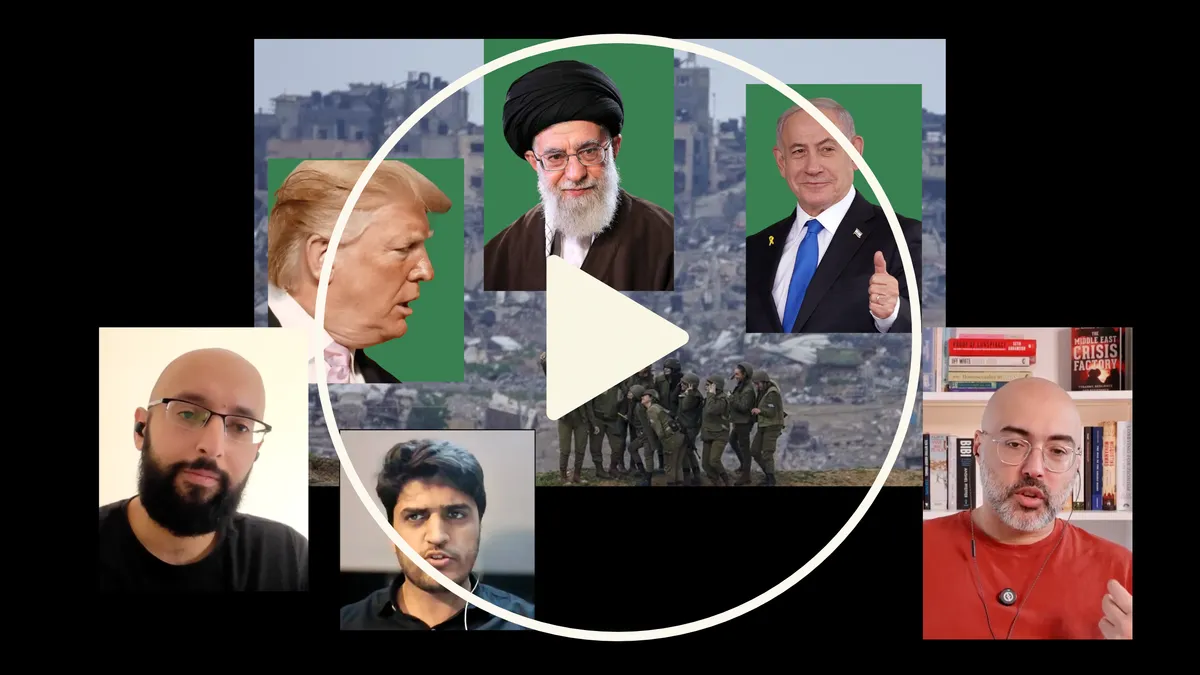
Welcome back to the Arab Tyrant Manual podcast. It's been a long time, friends and listeners—three and a half years since our last episode. We're back because the moment demands it. In this episode, we talk about the ongoing US-Israeli attack on Iran and how a war that looks irrational from Washington starts to make sense when you understand it as an Israeli-driven war the United States was pulled into. We trace the settler colonial psychology that drives Israeli strategic thinking, the October 7th turning point that shattered the illusion of a managed conflict, and why Israel is now locked into permanent, open-ended war with no offramp. We look at Iran's resilience, the vulnerability of the Gulf economies, and why this war is more likely to grind on than resolve cleanly. None of it is comfortable, but unfortunately, all of it matters.
We also have a big announcement: this podcast is being rebranded to become part of something larger that we're launching—Kulna, a new editorial platform for long thinking about power, resistance, and what comes next. There's a link in the episode description and more details at the end of the show.
So to get the obvious out of the way, this is a bizarre, irrational war which the US seems to have entered without a plan, without clear success conditions defined, without clear objectives, without adequately preparing for any of the consequences—be that the effect on global energy markets and its own economy, the effect on its allies, or the security needs of its partners in the region. The war just doesn't make sense if you think about it as America's war. It does make a lot more sense when you think about it as an Israeli war which the US got sucked into, because Israel did begin the war—it initiated the first strikes, and the war was also something that Israel advocated and pushed very hard for for years leading up to it. They even attempted to start it last year. The war is really clearly and obviously in the strategic interest of Israel more than the US.
Is there anything you disagree with? No, no, absolutely. I mean, I think this is why in the thread that I put out, I started from Israel's logic—and I started really from not just the strategic side, but the psychological side. A lot of people now—we're writing right now as the war is entering, I think, its fourth week—the mood already is that this has crossed over into attrition, but it's still a good idea for us to remind everybody where this started. It didn't really start with America's calculus; just like you said, Ahmed, it really starts with Israel's calculus.
I offered this explanation, which is kind of counterintuitive. A lot of people will think in terms of what is strategically important for Israel, or they will think in terms of the whole messianic beliefs, Greater Israel, etc.. For me, from my perspective, I think you really have to understand Israel's psychology first of all. Because a lot of what Israel does collectively—I know when I say 'Israel' it's a big word, I'm not talking about every single Israeli—there is kind of a collective psyche that's at play.
You see, the Israelis are a relatively small population—7.5 million Jewish Israelis in the vicinity of around 600 million Arabs and Muslims around them—a settler colonial origin of the state, where settler colonialism is still functioning very strongly. There is a certain psychology that comes with it. Recently, I've been reading a book called The Colonizing Self—I forgot the name of the author—but she's writing about the psychology of what it takes for you to build your home on the ruins of others that you have displaced. The psychological element is very important.
The early founders of the state of Israel—if you go, for example, to sections from Ben-Gurion and Moshe Dayan, curiously both written in 1956 around the time of the Suez Canal crisis—were very clear-eyed about what it takes for Israelis to exist in this kind of vicinity. They knew that this means always fighting, always living by the weapon, by the bayonet, always being ready to attack, always being ready to be attacked. This functioned for a generation—the first generation of the existence of the state of Israel—until the aftermath of 1967, but really after 1973.
In the 1967 Six-Day War, Israel defeated multiple Arab armies, occupied the West Bank, Gaza, Sinai Peninsula, parts of Lebanon, the Golan Heights in Syria, and parts of Jordan. Curiously enough, many people don't know this, but before the 1967 war, the closest ally of Israel was not the United States—the US had not yet picked who it wanted as its main security contractor in the region. The closest ally of Israel at the time was France, because France was fighting an anti-colonial war in Algeria and saw the Arabs as a common enemy. In fact, the technology Israel needed to create its own nuclear weapon came from France, not America.
After 1967 and the 1973 oil crisis, the US imperial system started to mature. Before 1979, the main security contractor of the United States in the region was not Israel—it was the Shah of Iran. The 1979 Iranian Revolution flipped that, turning a pro-Western country into one of the most anti-American countries. After that, Israel became the main security contractor and co-constitutive—a core part of the US imperial system.
During this period, because Israel felt safe as part of the imperial core, a pseudo-liberal narrative emerged where the founding spirit of 'fighting everyone all the time' took a backseat. But after the peak of the imperial system around the Iraq war and its post-2008 degradation, October 7th, 2023 marked a turning point in the Israeli psyche. It activated that part of the psyche that says our existence in the region can only be through unrestricted war.
I have argued that the war that started after October 7th is Israel's last war—not because Israel's defeat or victory is imminent, but rather because Israel is going to be in a condition of constant military engagement and conflict as a condition of its existence. Structurally speaking, Israel is going to keep starting new wars; even if it wins in Iran, it will move to the next target. This is not just about Netanyahu. We've heard Yair Lapid—the centrist—talking about Greater Israel, and Naftali Bennett talking about Turkey as the next threat after Iran, as well as worries about Qatar and Egypt.
Between the withdrawal from Gaza in 2005/2006 and October 7th—a period of 18 or 19 years—Israel maintained a violent equilibrium where it kept the Palestinians contained. It thought the Palestinian problem was solved. October 7th destroyed this equilibrium and the idea that this is a managed conflict.
Israel is also running out of time due to shifts in US public opinion and the normalization of criticism of Israel. Without American support, Israel cannot maintain its hegemony or survive in its current form. The aggressiveness right now reflects a sense of running out of time. This creates a spiral: the more violence they use, the more isolated they become, which is taken as proof of an existential threat that justifies more violence. What we are witnessing is Israel's death spiral—lasting perhaps 10 to 15 years.
Shifting to the US: what does the US actually want out of this military campaign? Public narratives shifted from regime change to concessions, disarmament, removing ballistic missiles, and nuclear weapons. When it comes to Trump's temperament, commentators note he is impressionable, has a massive ego, and was affected by snub over the Nobel Peace Prize. He thought this would be a quick four-day war where Iran would grovel.
He was dogwalked into this war by Israeli lobbyists and Zionists in the administration. Additionally, Trump used war as political distraction—including surrounding the Epstein files. Unlike previous administrations with institutional logic, Trump's authoritarian bent means his personal will dominates.
America started the war with high escalation by calling for regime change, dictating an existential pace for Iran. When the US backtracked, it lost escalation control. While Israel declares victory merely by degrading Iranian infrastructure, America has no clear logic or win condition. Escalation control is now firmly with the Iranians, who intend to exact such a high price—including targeting $200/barrel oil—that another round becomes unthinkable. War is violent negotiation, and Iran's walk-away option appears stronger.
The Gulf states represent the soft underbelly of the US imperial system because their pain tolerance is low. When the war started, Gulf allies were shocked and angry. Emirati businessman Khalaf Al Habtoor wrote a viral post excoriating the US and Israel for dragging the region into a war without consultation. However, within days, posts were deleted as authorities regained messaging control and fell back in line with official US alignment.
The main fragility of countries like the UAE and Qatar is their demographic makeup. They are classic rentier states where 88%+ of the population are non-citizen foreign residents. Residencies are tied strictly to employment, and there is no social safety net or welfare system for non-citizens. As businesses face cutbacks, pay cuts, or layoffs, residents face immediate survival crises.
If non-citizens leave, aggregate demand collapses, triggering a deflationary spiral where reduced demand leads to further job losses. In an extended war of attrition lasting months or a year, severe economic fatigue will set in.
Regarding Iran's internal dynamics: the regime was built from the ground up to be coup-proof and ideological. It features two military structures: the Artesh (the conventional national army) and the IRGC (the Islamic Revolutionary Guard Corps). The IRGC reports directly to the Supreme Leader, protects the revolution, and controls up to half of the Iranian economy. Sanctions actually strengthened the IRGC by giving it monopoly control over ports, logistics, and factories.
To understand public reactions, we must separate Iran into three layers: 1) The State: The fundamental geographical/national entity; 2) The Regime: The form of government and coercive elite capacity; 3) The Administration: The specific political authority of the time.
Because Israeli and American strikes threaten the Iranian state itself (with talk of partitioning borders), it triggers a 'rally-around-the-flag' effect even among citizens critical of the regime. Furthermore, the IRGC uses a decentralized cell architecture designed to function autonomously under decapitation strikes.
How does this end? Iran will likely keep going until global or regional economic systems break to re-establish deterrence. Iran will demand any ceasefire include Lebanon, Iraq, and Yemen, which clashes with Israeli goals.
Within the US establishment, figures like Pete Hegseth and Lindsay Graham have come to the fore while JD Vance has faded. Trump's shift to a war posture stems from legacy-seeking, health concerns, ego, and heavy Israeli influence.
Regarding the Gulf states: Saudi Arabia's Mohammed bin Salman (MBS) and Qatar explicitly do not want this war or regime change in Iran. War disrupts MBS's Vision 2030 development plans. Claims that Saudi Arabia pushed for the war represent Israeli disinformation. The massive financial investments and weapons purchases by Gulf nations have ultimately failed to buy security or influence over US decisions.
The rise of authoritarian populism, technological disruption, economic centralization, and geopolitical conflict are interlocking forces compounding instability. Most commentary is trapped in the present tense of social media and news cycles. If nobody thinks in generational terms, we only deepen crises.
Kulna exists to change that. Rooted in the MENA region's histories, struggles, and futures, Kulna sits at the intersection of geopolitics, culture, technology, economics, and resistance. Our simple conviction is that human life and human dignity are non-negotiable. 'Kulna' is Arabic for 'all of us'—because we're not free until we're all free. Find out more and become a founding member at kulna.co.