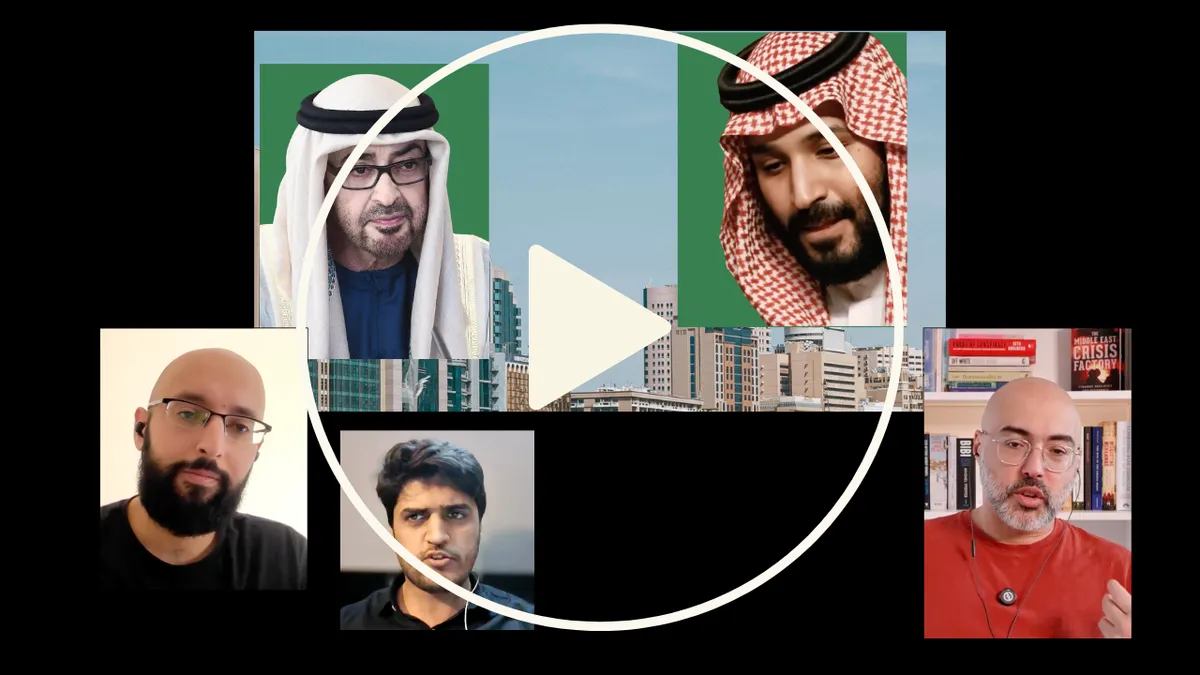
Will the Gulf make it
Published 25 April 2026Chapters
- 00:00 Introduction & The Core Question of GCC Viability
- 05:00 Financial Market Disconnects, Brent Crude & The UAE Dollar Swap
- 12:00 Citizenship Stripping & Rentier Demographics Under Stress
- 18:00 Strategic Security Dilemmas — Five Choices Facing the GCC
- 32:00 Authoritarian Consolidation & Crackdown on Civil Society
- 40:00 Long-Term State Viability & The Al-Nafisi Thesis
- 47:00 The UAE's Structural Transformation — Sheikh Zayed to MBZ
- 55:00 Regional Escalation Dynamics & US-Israel Alignment
- 58:00 Conclusion & The Mandate of Kulna
Transcript
Ahmed Gatnash: Welcome back to the Arab Tyrant Manual podcast. This is our second episode back and we're recording in the middle of one of the most unstable moments the region has seen in years. In this episode we ask a question that sounds abstract but isn't: Do the Gulf States have a future? Not in the next news cycle, but in the next generation.
We look at what the war with Iran has exposed about the structural fragility of these countries—their rentier economies, their tiny citizen populations, and their dependence on a migrant workforce that can evaporate the moment the economy turns. We talk about the wave of denaturalizations sweeping Kuwait and Bahrain—governments stripping their own citizens of citizenship at the exact moment they most need those citizens' loyalty. And we talk about why states under stress don't reform, they just become more of what they already are.
We are part of Kulna, a new editorial platform for long form thinking about power, resistance, and what comes next. More about that at the end of the show.
For now, I'm Ahmed Gatnash, I'm joined by Iyad el-Baghdadi and Muhammad Saad. And this is the Arab Tyrant Manual podcast.So the first thing I want to talk about is the experience of being gaslit. Because we recorded our first podcast episode in 4 years a couple of weeks ago.
We talked about the Iran war and we happened to time that a little badly because it came out just after the ceasefire happened, and it looked like this whole thing that we've been talking about—and basically having a very cynical perspective about the prospects of a resolution and saying that the return to a status quo ever is impossible—and then immediately afterwards they start saying like, 'Oh we've found a negotiating path, there's a ceasefire now, now we're opening the Strait, energy markets are going to normalize.'
And my go-to kind of heuristic over the last month has been to look at energy markets and specifically the price of Brent crude. Because WTI, which is the other big one, is American and is not so exposed to disruption because America is pretty self-sufficient with oil. Brent crude is very internationalized, and it basically crashed from a high of around $115 down to back below $90. And everyone's saying it doesn't make sense. I'm watching Bloomberg, I'm seeing experienced energy market analysts saying that traders and investors are basically pricing in maximum optimism and ignoring all of the worst case scenarios, just assuming like, 'Yeah no, we will find a way.
The Strait will somehow open and we'll catch up on all those missed shipments and no one will be hit by disruptions.'And for a while, watching it crash last week, I actually started doubting myself—like did we get it wrong? Have we made some humongous blunder in our analysis? And then of course over the last two days, watching negotiations completely collapse again for what feels like the hundredth time, obviously someone's making terrific money off of insider trading off all of these headlines with hundreds of millions of dollars—probably someone whose surname is Trump or someone who's friends with Trump.
Iyad el-Baghdadi: Yeah, and it's just really bizarre to see this complete dislocation between reality as we're observing it and reality as being perceived by the financial markets which are kind of placing stock by Trump's words.
Whenever we do these knowledge calls, we're always having to comment on what's happening in the world, but also to talk about the knowledge subject that we had prepared, because the knowledge call is a reflection of our internal research.
So ahead of this point, as of last week, we wanted to speak about the Gulf States and their viability and the repression that's befalling some of our colleagues and friends in the Gulf States. But it's absolutely a fact right now that we don't know what world we're going to be living in by the end of the week.
We don't know if the world is going to restart. We don't know what condition the markets are going to be in.But the point that you mentioned, Ahmed, about the disconnect between the physical market and the financial market—we have an economist with us on the call, Christina, and the whole logic of financial markets was that it sends money where it is most efficient.
It's supposed to be sending capital where it is most needed. But here we see a complete disconnect between the price signals in the physical market and the price signals in the financial market. And of course, someone is making a lot of money on this.Saad sent me something about this over the weekend about how right before the ceasefire call, someone shorted a lot of positions related to oil. It's insane. I didn't think in my wildest dreams that the collapse of the US imperial system is going to be this stupid.
If you make it into a drama, someone would say, 'Hey, this is way too on the nose.' The collapse of the US imperial system is being insider traded by the president's sons and the people around him.Another piece of news that I saw today—this might help us swing to the Gulf States—is that the UAE is asking for a dollar swap with the US Treasury. The UAE, as with many of the Gulf economies, is a dollarized economy in the sense that the Dirham is pegged to the US dollar (~3.67 AED = 1 USD).
In order to maintain the peg, they have to maintain foreign currency reserves and get a lot of dollars, which is normally easy because they sell their oil in dollars. Now that they're not selling as much, can they support the currency peg?The Wall Street Journal reported that either the US Treasury has to help support our currency, or they're going to be forced to sell some of their oil in Chinese Yuan.
This makes sense because the markets most dependent on Emirati oil are Asian economies. Most commentary in major papers says, 'Yeah, this is really bad, but they'll bounce back.' But technically, under the surface, massive amounts of damage are being done.In crypto, there's an acronym: NGMI ('Not Going to Make It').
Decades ago, a Kuwaiti intellectual named Abdullah Al-Nafisi argued that the long-term future of smaller Gulf States is that they will ultimately be consumed into larger powers like Saudi Arabia or Oman. He's been demonized for saying his own country is not going to make it, but people are quoting him more now.Look at Kuwait: up to 1 in 5 citizens are set to lose their citizenship in a massive stripping rampage, downgrading original citizens to naturalized status so they can be stripped.
Today, Bahrain issued a similar statement saying they will audit who deserves citizenship. In the UAE, they are cancelling Golden Visas, targeting Pakistani Shia and long-term Iranian families who have lived in the UAE for 40 years across generations.
When systems get stressed, they rarely reform—they double down on their core logic and become more of themselves. The word 'citizenship' in the Gulf does not mean civic nationalism; it functions completely differently within a rentier structure.
If you are a country facing an adversary the size of Iran, what are your options? I'd say there are five paths:1. Build your own independent power and deterrence.2. Maintain strict neutrality.3. Join the war on the side of the US and Israel.4. Double down on being protected by the US imperial security umbrella.5. Accept Iranian hegemony.
Ahmed Gatnash: So it sounds to me like their options are basically continue to invest in the US imperial system and stay under that security umbrella, try to go back to some status quo of relations with Iran, pull a Turkey by being friends with everyone, or become an independent power with its own power projection.
Iyad el-Baghdadi: Exactly. If we break down those options:Option 1 (Build Independent Power) is IMPOSSIBLE. Why? Because the majority of people in these countries are non-citizens, and you cannot make them citizens without destroying the political economy.
The native citizen population is tiny—UAE has 1–2 million citizens out of 11 million residents, Qatar has 300,000, Kuwait has 1.5 million. The total GCC population is 50–60 million, but over 50% are non-citizens.Historically, these states created rentier economies where citizens don't pay taxes; instead, the government hires them.
They are dependent subjects. Furthermore, regimes intentionally avoided building large national armies because large armies risk military coups.
Ahmed Gatnash: I can see Saad smiling because Pakistan has a good history with military coups!
Iyad el-Baghdadi: For more information on large armies, check out the history of Syria, Egypt, Libya, Sudan, or Iraq! One reason Gulf states had less internal repression historically was because they felt secure under the US security umbrella (the Carter Doctrine).
They didn't need large armies or contentious internal politics.So Option 1 is foreclosed. Option 3 (Joining the War) adds minimal military value beyond what the US Navy and Air Force already possess, while painting a massive target on their own infrastructure.
Accepting Iranian hegemony (Option 5) is unacceptable to them. That leaves Option 4—doubling down on the US imperial system—not because it's their favorite option, but because they are out of alternatives.
At the moment when these countries are most threatened by external forces and global trade breakdown, they default to declaring war on their own population—stripping citizenship, arresting intellectuals, and silencing critics.
Ahmed Gatnash: And while we're talking about the Gulf States basically waging war against their own population, I'd be remiss not to mention our friend Ahmed Shihab-Eldin (Ahmed Jihad), a prominent Kuwaiti-US journalist who was arrested for journalism and has been in prison for over a month alongside lawyers, public intellectuals, and academics like Dr. Sajed al-Abdali.
These are people who lead public debate, educate society, and make a country robust. A wise government protects and elevates them. Instead, these regimes arrest, silence, and denaturalize them because they view money, oil, and foreign weapons as their only relevant assets—not their people.
Iyad el-Baghdadi: Of course, we wish Ahmed the best. My prediction is he will be denaturalized and expelled. I was in a similar position when I was imprisoned in the UAE as a stateless Palestinian.
Before prison, I felt resentment about never gaining citizenship. In prison, I realized I was lucky because I could be expelled, whereas Emirati citizens face lifelong imprisonment as 'traitors'.
By locking up public intellectuals, these regimes destroy their own collective IQ and talent pool. It mirrors what happened during the post-2011 Arab Spring purges and MBZ's crackdown, as well as Saudi Arabia's 2017 arrests under Mohammed bin Salman.
They don't want an awakened citizenry that asks critical questions.
Muhammad Saad: Okay, I have a question. I think it's good if we can go back to history, because as a Pakistani, we had a very different relationship with the UAE.
Right now our relationship with the UAE is at its lowest, but before Mohammed bin Zayed (MBZ), under Sheikh Zayed, things were completely different.
Where did they miss this train? From where I am sitting, we kind of saw this shift coming.
Iyad el-Baghdadi: That's a very important clarification. Under Sheikh Zayed, the founding father of the UAE, foreign policy was based on traditional Arab tribal diplomacy—seeking compromise, reconciliation, and consensus.
He was a benevolent tribal leader, not a thuggish autocrat.After Sheikh Zayed died in 2004, power shifted toward his son, MBZ. The 2008 financial crisis was a major turning point: Dubai faced financial distress and required an Abu Dhabi bailout (symbolized by renaming Burj Dubai to Burj Khalifa).
This centralized power in Abu Dhabi and transformed the UAE into a centralized security state.Under MBZ, the UAE adopted an aggressive, interventionist foreign policy relying on foreign mercenaries in Yemen, Sudan, and Somalia.
They expanded rapidly without expecting blowback, creating a post-modern empire that lacks long-term sustainability.
Ahmed Gatnash: What's the zoom-out perspective here?
Iyad el-Baghdadi: Systems under stress very rarely use that stress to reform and improve. Instead, they double down on their core flaws, accelerating their decline. The UAE has projected power across Sudan, Yemen, and Somalia, but as internal and financial pressures mount, maintaining those foreign interventions will become impossible.
Ahmed Gatnash: I'd also temper it by saying that these transformations play out over generations. Whether it takes 15, 20, or 30 years, the foundational structure of these city-states is under extreme strain.
Muhammad Saad: I'll just add regarding the current military outlook: looking at troop movements, weapons shipments, and US Marine deployments under the Trump administration, it appears they are preparing for potential ground operations, possibly around Qeshm Island.Despite attempts by Pakistan's military leadership and intelligence chiefs to mediate between IRGC officials and Saudi leadership, Washington shows no serious interest in genuine diplomatic negotiation.
Iyad el-Baghdadi: To bring our conversation full circle: to understand this crisis, we must recognize that this is fundamentally Israel's war—dragging in American power and exposing the existential fragility of the Gulf states.
Ahmed Gatnash: If this conversation matters to you, please share it and support our work so we can produce more long-form analysis. You can become a founding member at kulna.co. Thank you for listening.
— End of Episode Transcript —