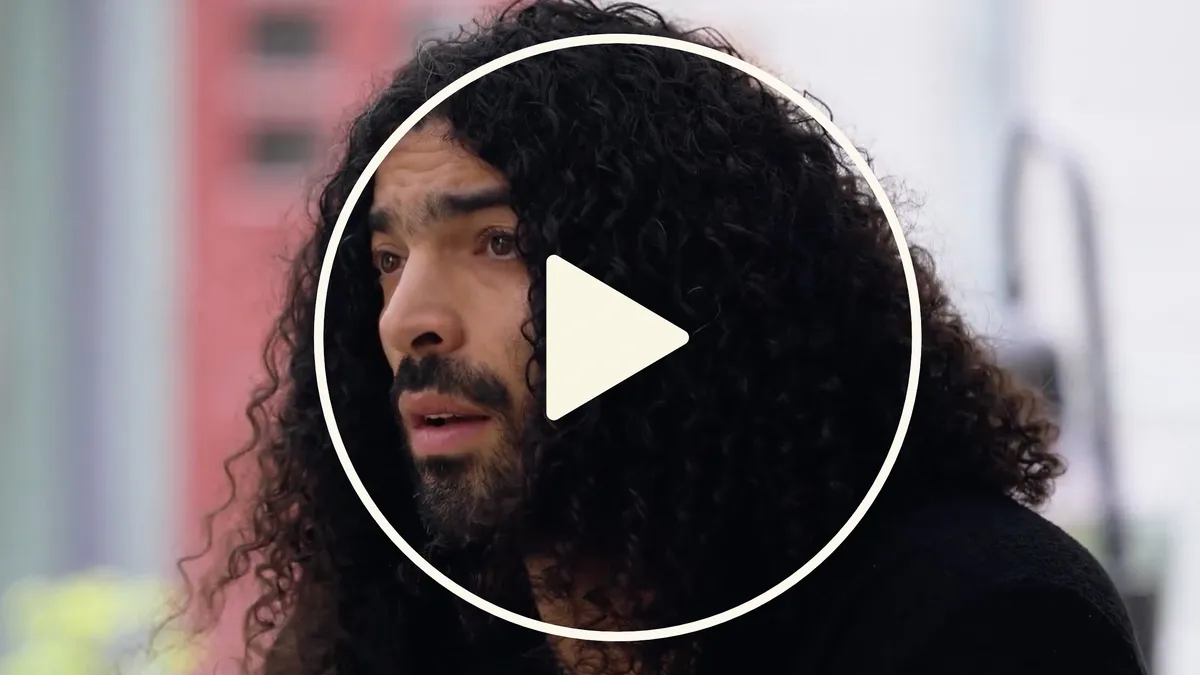
Ramy Essam draws his own demons
Ramy Essam talks about his torture, his healing journey and his art therapy project and framework, "Boogies".
Published 21 September 2026This interview is produced by Olli Romppanen and Aleksi Sirvlö in July 2024. It took place in Galleria Linnankatu 13 in Savonlinna, Finland, where Ramy exhibited his artwork "Boogies".
Chapters
- 00:00 Introduction
- 08:24 First topic
- 22:10 Second topic
- 00:00 Discovering Visual Art Again
- 01:07 Introduction
- 01:45 Music, the Revolution, and Its Costs
- 04:07 Trauma and the Road to Healing
- 05:25 How the Boogies Are Born
- 06:42 A Color Language for Feeling
- 08:02 Sharing the Boogies with the World
- 09:48 Torture, Purpose, and the Power of Art to Heal
- 11:21 From Digital to Lithography
- 12:35 The Group Exhibition Experience
- 13:47 Boogies as a Universal Language
- 14:51 Music as Duty, Boogies as Freedom
Transcript
...being a visual artist now is something that should have started long ago. It was the first talent, the first gift I received from the universe. I found it when I was about three years old — I still have drawings at home from that age.
I started to draw before I could even form full sentences, and I always saw myself as a painter, as a visual artist. But drawing and painting were so closely tied to my father, whom I lost at the age of twelve, that I stopped drawing without realizing why. I didn't understand, at the time, that it was connected to that loss. It was only about twenty years later that I returned to drawing — to save my life, to fulfill my own dream, and to fulfill my father's dream as well, since he had always supported it. That is why anything I create in my visual art will always be dedicated to his memory.
I'm Ramy Essam. Born and raised in Egypt. I have been in exile for ten years. I've always been known as a musician, a rock artist, and a human rights defender. At the moment, I'm enjoying an important new chapter in my life: becoming a visual artist as well — which was actually my first dream, since I was a child. Now I am one, and it feels remarkable to be here.
I started making music at seventeen, purely for enjoyment. From twenty to twenty-three, I began writing political songs, and by the time the Egyptian revolution began, I had twenty-five of them ready. So when I joined Tahrir Square in Cairo, joined the people and the movement, I had something to sing and something to say.
Because of that music, I was arrested and tortured on the ninth of March, 2011. I continued the fight through my music. In 2014 I was arrested again for the same reason and threatened in ways that made it impossible to continue. I was then facing conscription into the army — an absolute refusal for me, since I will not carry a weapon or take orders that could harm another human being, and my relationship with the Egyptian military was already adversarial. I had to leave Egypt, intending to return once I turned thirty. That is how I ended up in Sweden, and later Finland, on artist-at-risk residencies, continuing to support my movement from a distance. Conditions only worsened, and I have not been able to return to Egypt since — that remains the situation today.
I kept releasing music, and in 2018 I released "Balaha," a song that led to an arrest warrant against me and the imprisonment of seven others. The director, Shady Habash, lost his life in detention due to medical negligence. The lyricist, Galal El-Behairy — a comrade and friend — remains imprisoned to this day, more than six years on. That same year, my passport was canceled, leaving me stateless and unable to leave Sweden.
All of this accumulated into significant trauma and PTSD — compounded by the friends and comrades we lost in the revolution, and the violence I witnessed firsthand. For ten years I denied and ignored it, which is something I would urge anyone carrying trauma, however large or small, not to do: in the end, it is PTSD, and it has to be addressed. I did not address mine, and by 2021 — ten years on — my body began to break down under the weight of it. Had I dealt with it sooner, the process would have been easier. Instead, it became one of the hardest experiences of my life. I had to work hard to heal and to stand on my feet again, and one of the things that helped most was visual art — the Boogies. That is why I still make them today.
That is the brief story of why the Boogies exist. How each one is actually made is a very intuitive process — I have no idea beforehand what I'll do, how it will look, or how it will end. I simply start with a blank sheet and let lines, shapes, and abstractions emerge, guided by my subconscious. The moment a Boogie is finished, I see it for the first time in exactly the same way anyone else would.
Every Boogie stays black and white until the final phase, when I choose its color. Once a piece feels complete, I speak to it, in a sense, and that is when I discover whether it wants to be red, orange, pink, blue, or remain black and white.
Through the Boogies, I've developed a language over the course of my healing — a way to communicate my feelings, my struggles, and my journey. In that vocabulary: red is reflection, orange is the inner self, blue is wisdom, pink is feeling and emotion, and black and white holds all of those aspects together.
This language lets me express what I'm going through without obstacle or overthinking — something everyday language often fails to do, either because it isn't sufficient, or because none of us were taught, as children, how to put feeling and struggle into words. For any artist, or anyone, finding a medium that builds that kind of language is invaluable. That is why the Boogies matter to me as a daily practice.
When the Boogies became public, that was never the plan. I had no intention of sharing them with anyone — they simply began appearing as part of how I was healing and surviving my PTSD. At this point I have made 1,092 Boogies in under three years, and I don't think the idea of sharing them with the world occurred to me before roughly Boogie number 600.
Why do I keep making them? Because they keep me sane. They heal me. I am surviving through them, and I believe I will keep making Boogies until my last day. People sometimes ask when the Boogies will stop — I don't think they ever will, because a Boogie made right now would be different from one made thirty minutes from now. Each reflects how I feel in that exact moment.
So making Boogies is, first, for my own sake and my own wellbeing. Sharing them with the world came later, encouraged by people close to me.
I was tortured on the ninth of March, 2011. Afterward, at twenty-three, I began searching for something I could do to prevent other people from experiencing that kind of violence. As I got older, I saw more clearly how difficult — how ugly — the world can be, and how hard it is to actually stop torture from happening. I lost my sense of direction with that mission, and for years I was deeply disappointed that I couldn't do more.
Sharing the Boogies gave that purpose a new form. If I cannot stop people from being tortured, I can at least encourage them to use art to heal, to cope, to survive. That feels like a way to help people who have lived through experiences like mine. So I make the Boogies for myself, but when I share them, I want to encourage others to find any artistic medium that helps them heal — because art is an extraordinarily powerful tool for healing.
The Boogies are always created digitally, but I wanted to bring them into physical form, made by hand. I experimented with several methods — I like silkscreen printing — before discovering lithography, and I fell in love with the process: how the work is made, and how directly involved the artist is, drawing the Boogie onto the stone itself. It was a genuinely enjoyable process, and holding the finished print was deeply satisfying. I plan to keep experimenting with other methods, but lithography will always be an anchor I return to.
Working with the team in Helsinki was a wonderful experience, and one I'm continuing.
As a musician, making music is never a solo act — it's teamwork. My first exhibition, in Sweden, was a solo show, but this one is my first group exhibition, and I'm honored to be included among artists with such long, accomplished careers. Building the exhibition felt very similar to working with other musicians on a piece of music: finding the harmony between different pieces, shaping the energy, arranging it all so it holds together. The gap between a recording studio and an exhibition space, in that sense, is smaller than it seems.
The atmosphere and energy in the room mirrored that experience closely, and I learned a great deal from being part of my first group exhibition alongside these artists. It was genuinely educational.
Boogies can absolutely be a universal language, because anyone can create their own version — and it doesn't need to take the form of visual art. That is one of the central missions I want to fulfill through this method: encouraging people to find any kind of art that helps them heal and survive their trauma. You don't need to heal through my Boogies specifically — I want you to make your own, in whatever form suits you. I see this idea extending everywhere, and I look forward to that. When I visit new places, I don't just want to show my work; I want to talk about the power of art in healing trauma, and to encourage people to use art to heal. That is the larger goal behind the Boogies.
Making Boogies daily, to survive and to heal, and now sharing that practice with the world, matters to me deeply — because for many years, music was my creative outlet for healing. Since 2011, though, and the start of the Egyptian revolution, my music became bound up with persecution, oppression, violence, torture, death, imprisonment, and exile: a great deal of sorrow, hard feeling, and trauma.
Music remains essential — it is who I am, at the core. But the political music, in particular, has become more of a duty now: a responsibility to my message, to my movement, to my people, and to the broader responsibility of an artist to use art to make the world better and to drive change. That responsibility always comes with struggle and hardship.
With the Boogies, over these past couple of years, and through the experience of sharing them, I've rediscovered what it means to be free as an artist — without second-guessing what I make or how I make it, without the caution that political work demands. Music carried that same freedom for me once, before the weight of fighting large systems and regimes made it harder to sustain. I will keep making music until my last breath. But I'm grateful to have found, again, the freedom of making art purely because I feel it, without thinking about anyone or anything else. Whatever is inside comes out, and it heals — and it's powerful. That is why the Boogies will always be there.
— End of Episode Transcript —