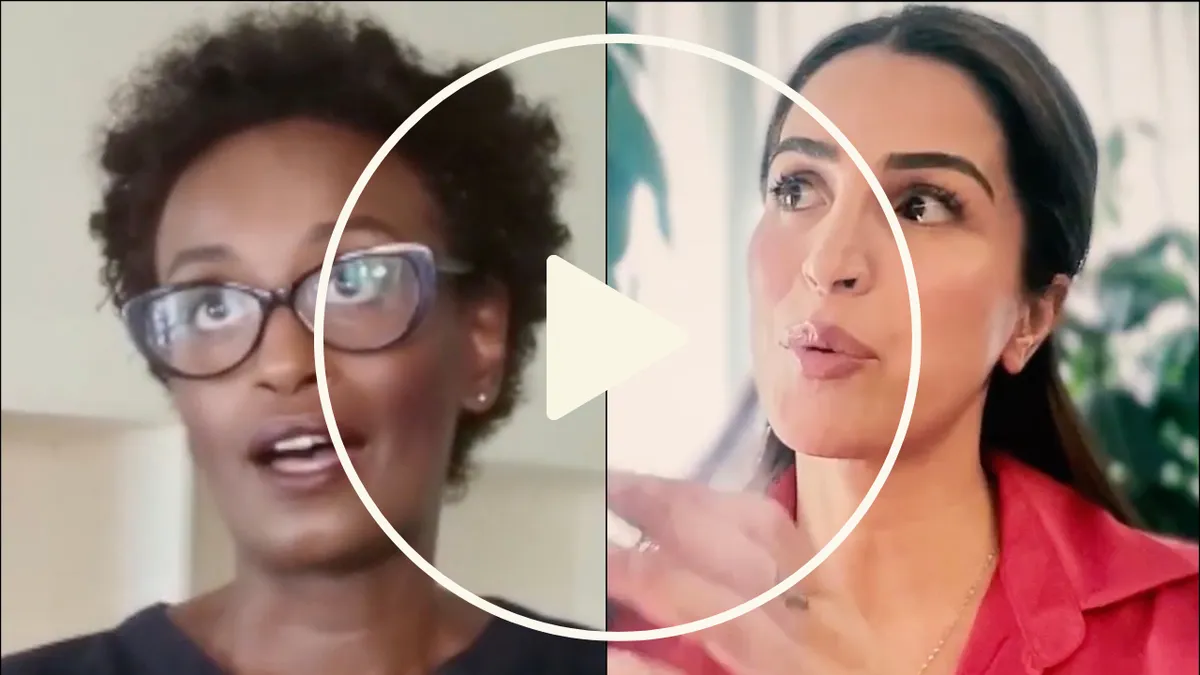
Shefa Talks: Leyla Hussein
In the first episode of Shefa Talks, we interview our own colleague, Somali-British therapist and feminist Leyla Hussein. We talk about burnout, self-care, and her principle of "Do No Harm"
Published 22 September 2026Chapters
- 00:00 Do No Harm - Origins and personal journey
- 08:24 Shame, guilt, and the activist identity
- 22:10 What shapes an understanding of care
- 00:00 Education, systems, and structural neglect
- 00:00 Race, power, and who gets to tell their story
- 00:00 Entering a space - the practice of care as a therapist
- 00:00 Implementing Do No Harm in organisations
- 00:00 Practical tools for every day
Transcript
ISABELLE: Leila, hi. I have many questions for you, but I want you — in your own words — to speak to 'do no harm.' It is a concept that you have been inspired to manifest, to make into practicality. So before we start talking about framework or language, in your words, what does do no harm mean?
LEYLA: My understanding of do no harm really comes from my own personal journey. Going back to my early activism — this is two decades ago now, please do not try to figure out my age — it stems from experiencing early trauma and working in systems that were not safe. As an activist, you want to do good, but when you are working against issues around violence, the environment takes its toll. I was working very closely with frontline activists, and that showed me how often care — or the lack of it — defines the work.
LEYLA: I was lucky in a sense, because this conversation began for me through a really close friend — someone I believe practically saved my life at one point. Her name is Jennifer Bourne. She was my first boss when I stepped into activism. My early work was around fighting female genital mutilation here in the UK, which is also something I experienced personally as a child. So as you can imagine, childhood trauma was surfacing on a daily basis.
LEYLA: Jennifer — who was a specialist nurse and psychotherapist — was one of the first people to stop me and say, 'We need to create a better system for you.' I didn't listen at first. But she created a safe space and told me I needed to take time off, go into therapy, and that I would only come back when I was ready. And crucially — I would be fully paid.
That mattered because I was a single mom. Salary was everything. I ended up being off work for nine months. That is how long it took to recover from the severity of that burnout. That is really where my understanding of do no harm began — because if you don't have the right care and strategy in place, that is what happens.
And I remember the deep shame of that whole experience, but also the gift of someone sitting with me through it without judgment.
On Shame, Guilt, and the Activist Identity
ISABELLE: You talk about burnout and the feeling of shame — but you are also an activist, and being an activist is part of the identity you carry. How do you think that shame manifests within the activist part of you?
LEYLA: It stems from guilt, and also from the communities we come from — we are already raised with shame. If you are a Black or brown child of an immigrant living in Europe, you already carry that message: you better do better, you better work ten times harder, you are not allowed to make mistakes.
You are not allowed to fall apart. So when the burnout comes, and you do fall apart, you cannot work anymore. I remember only my siblings knew I had taken time off. I could not tell my mother. I felt I had let down not just myself, but my child, my family.
And when you are physically on the front lines, there is that added weight — I had activist friends in Africa who were fighting perpetrators of violence in their own villages. And I felt this guilt: how come they can still be standing, and I cannot?
LEYLA: That shame is deep and ugly, and we do not talk about it in activism spaces. What happens is it becomes burnout, then exhaustion, and then it projects outward as anger.
I am sure you have heard of activists who were fighting against dictators and ended up becoming dictators themselves within their own organizations — because that is literally what we were taught.
You have to be like a dictator to run something. Not kind and gentle. Not someone who takes time off. So the shame and guilt are constantly fuelling each other in this space.
ISABELLE: I would not call myself an activist, but I was a field worker for Doctors Without Borders. I worked in a refugee camp for two years, and I carried this sense of responsibility — that I was a caretaker, a support figure to those people.
And I think it is the same with activists: the moment you take a break from being that person, that caregiver, you feel as though you are letting down the people, the cause — everything.
And there is a point where the body, the mind, the psyche just says: enough. I personally found it very shameful when I came back from fieldwork.
LEYLA: I think it is important to also speak to this idea of who is or is not an activist. When you have a view about any social issue, regardless of which organisation you work for, I think you are an activist.
We all have that within us. I have known you for a while, and you are definitely an activist in my eyes. That is why you felt the way you did — because otherwise you would not have cared.
LEYLA: And what you experienced is what we call secondary trauma. You may not have experienced the trauma directly yourself, but by hearing it, writing about it, and supporting it, you have embedded that trauma into your body.
It feels as if you have lived it. Organisations often do not have the tools to even acknowledge this, so a lot of people suffer in silence — especially people who were in roles like yours, because they are considered privileged.
How can you be upset when you are privileged? But people forget you are human first. You chose to be in that situation. You chose to support others in difficulty. But you are also a human being who has feelings when you leave. Organisations do not necessarily look at returning field workers as people who need support, because the assumption is they went back to their safe home and they are fine.
ISABELLE: When I look back, I was the one telling myself I was not allowed to feel this. I was privileged — once I left the refugee camp, I went and had a hot shower, I had a bed to sleep in. A lot of field workers and activists put that label on themselves.
LEYLA: Because the contrast is too big. Absolutely.
ISABELLE: Before the role you have today, I know you have had a very rich life — within both pain and love. What has shaped your understanding of care? And I mean in the deepest sense.
LEYLA: Sadly, what really shaped my care was my breakdowns — not just one, but several. Because how else do you understand how to care for yourself until you have had that experience? When you break down in that way, you have to relearn basic things.
I remember working with clients who would say they had not brushed their teeth or showered because they did not feel the need to see anyone — not realising they needed to do that for themselves. Care was precisely that.
LEYLA: I recently had hip surgery, so I am still recovering. And there is this privilege of just showering by yourself — I found myself thinking, my god, I took that for granted. Those little basics.
I learned the importance of care through things that happened to me — spinal surgery, emotional breakdowns from activism work, relationship breakdowns. It is like your face needs to hit the ground. I hope we reach a world where people do not have to learn this the hard way, but that is genuinely where my level of care comes from.
LEYLA: People like Jennifer Bourne shaped it too. And then when I trained as a therapist — I thought I was going to learn how to speak to people skillfully, not realising that much of the work was going to be internal.
My professor would say: how are you going to hold space when you cannot hold space for yourself? I cannot talk to people about care unless I genuinely prioritise my own. And I will not lie to you — even today that is a struggle. My guilt kicks in. But it is a journey, and I am still learning. There is no endpoint, because the world keeps changing, and we have to adapt our care accordingly.
ISABELLE: I wish we did not have to learn through the fall.
LEYLA: I wish the same, and here is why: I believe our education systems — from primary school, from age five or six — fail us in three essential life areas. Healthy relationships. Finance. And well-being.
Those are three key life skills we need. How do I manage my finances? How do I recognise healthy and unhealthy relationships? How do I take care of myself? I spent hours learning algebra, and I do not think I have used it once since leaving school.
If I had learned these things early on, perhaps I would not have had those serious breakdowns — nine months off, with a condition like lupus and fibromyalgia that I sadly carry now, which is deeply connected to unhealed trauma. Because we were taught to just carry on.
LEYLA: I hear it all the time: Black women are so resilient. But we were actually rewarded for suffering. Tell me one activist who has won an award for taking care of themselves, for having healthy boundaries.
The activists who are glorified are those who suffered the most. In my well-being work with organisations and companies, I try to ask: why do we keep rewarding bad patterns? We need to break that cycle and change that culture.
As a Black woman, I do not want to be resilient. I do not want to be strong all the time. My body cannot take it. And that is the honest truth.
ISABELLE: We are constantly being reminded of all of this — through media, through world events. It becomes even more essential to have self-care and do no harm practices. But it also makes it harder. How do we increase the care?
LEYLA: There are patterns I see consistently. Frontline activists and survivors of violence face constant minimisation of their credibility by those making decisions. There is a short-term engagement culture — organisations enter, extract stories, and leave with no accountability. And our very existence is being minimised.
If I report something today from Somalia or Africa, it will not be taken as seriously as if a white person did the same thing. That is not disputable. We are seeing it. And what we are doing is constantly trying to reshape other people's narratives over and over again.
LEYLA: That is why it is so important that we, as non-European people, are assertive about our experience. There is fear of being seen as aggressive or violent when we assert ourselves — but that fear exists precisely because our existence has been minimised, and there is no accountability for those who do it.
Activists and survivors of violence are never allowed to be at the forefront of anything. They are only there to tell stories.
ISABELLE: Anyone who wants to disagree should look at what happened when the Ukraine war started — the outrage, the panic. And journalists on television saying these people do not look like they should be violated. I remember thinking: what does that mean for everyone else?
LEYLA: Exactly. I have been advocating against FGM for over two decades. It is one of the worst forms of sexual violence against children. But there is no outrage. Imagine if today a newspaper ran the exact same story about a white child.
There would be an international uproar. This is a pattern we see again and again. We are not allowed to speak about our own experience. And when others do speak to it, they minimise it.
ISABELLE: It is also about who the perpetrators are. If the Epstein files involved Brown Muslim people, the response would have been entirely different. It is not just about who the victims are — it is about who is allowed to be a predator, and how harshly we judge them. That depends on skin colour, religion, location.
LEYLA: I guarantee you — if Jeffrey Epstein had been a Black or Arab man, they would all be in prison right now. ICC courts. Everything. Because they are white men, we keep pretending this is not happening.
I remember once lecturing at my university. I put up a photo of an Arab man with his wives, then placed it next to a photo of Hugh Hefner and his much-younger girlfriends. I asked the students to tell me the difference. The silence. The shame on their faces.
The Arab man with a beard and turban is barbaric, monstrous. Hugh Hefner had a reality show. He was a respected man. The same behaviour. Completely different reactions.
LEYLA: The Me Too movement is another example. It was started by a Black woman named Tarana Burke, years before anyone had heard of it. But it only became a movement when white women spoke out. Because white women were being harmed. We cannot pretend we do not live in that world. We do.
ISABELLE: Race, gender, and location — those three things determine everything, really. What you are born into absolutely dictates how your life plays out. So this idea that we are all equal and democracy will save us...
LEYLA: It is total nonsense — mind my language. Democracy and freedom of speech only work for white men. Not even white women — white women have also been gaslit into believing they are free. Patriarchy was packaged very nicely for them. But they are not free.
ISABELLE: You and I grew up in Europe. We were told our lives were great. We should be grateful. I genuinely believed in equality, even while knowing in practice it was not true.
My real reckoning came with Doctors Without Borders, watching how the Greek authorities treated refugees simply because they were refugees. It was all a lie. A narrative designed to make you feel superior to everyone else.
LEYLA: Exactly. A narrative to make you feel superior when it was never designed for you in the first place. This system — the western capitalist calendar, the relentless productivity — was created by a small group of rich white men, for themselves. And we are all running around trying to catch up with something that was never designed for us.
ISABELLE: When you enter a space with dialogue or healing — as a therapist — what do you pay attention to first?
LEYLA: The first thing I always do is never assume every space is the same. Just because I worked with someone else before does not mean I apply the same approach here. I look at cultural differences — how does culture shape what it means to be in this space? I always co-create the space with whoever I am working with. I never treat a new space like the last one.
LEYLA: When I founded the first ever counselling service for FGM survivors in 2013 — mainly group work, because many of us, especially Black women, were suffering in silence, and community is central to our culture — I noticed very quickly that women who did not speak English as a first language needed to be grouped together by nationality and language. Somali women, Eritrean women, Ethiopian women. We would ask them: how would you like this space to feel?
LEYLA: I remember the Eritrean women's group asked if they could bring their spices and tea, and popcorn. That changed everything about how the group functioned. It taught me: when I walk into any space, I ask what tools I have — but also what do you need to bring into this space to feel safe? What does your culture need? Do we need to eat together? Sit together?
LEYLA: I was actually criticised by a mainstream therapeutic institution who said I was breaking every ethical code of Western therapy. And that was a moment of deep decolonisation for me. I was trained as a therapist in the West. I was never trained from the frameworks of my own people.
The Somali tradition, for instance, is to sit in a circle under a tree when there is conflict. Bringing that understanding into every space is how I work. I never assume. I do an assessment first. I want to know what you need. I am not here to decide for you.
ISABELLE: One of my roles with Doctors Without Borders was as a cultural mediator, precisely because of how dangerous misunderstanding could be. With 6,000 refugees arriving daily, you had two or three minutes with a psychologist to explain your symptoms.
I remember a sixteen-year-old Afghan girl who came in with her parents. The German doctor asked if she was pregnant. She said, 'I am not married.' In her culture, that is the answer to that question — it means no. The doctor repeated the question. The father heard what he thought was a confirmation. And this poor girl was beaten by her father that evening. That is how catastrophic a single cultural misunderstanding can be.
LEYLA: That story illustrates everything. Safety is an individual experience. You have to ask each person what safety means to them. It is not you assuming. Taking someone to a five-star resort is not necessarily creating the safest environment — but that is how it is often branded.
LEYLA: I learned early on that even language can endanger people. In my clinic, I removed the words 'counselling' and 'psychotherapy' from all materials — everything said 'well-being.' The women were receiving full psychotherapy, but if a leaflet was found in their home, it could put them at risk.
I had one woman who wanted to attend our group but lived nearby and could not be seen coming in. I actually went to the Pizza Hut next to our clinic and borrowed a hat and a pizza box. That woman would arrive pretending to deliver pizza. That is what safety meant for her. That is what do no harm looks like in practice.
ISABELLE: Before we round up — how does do no harm work in practice for organisations? If a company reached out to you, what would that look like?
LEYLA: The first thing I always ask is about intention. What is your end goal? Because one thing I will never be part of is a tick-box exercise. I am not going to trigger people and then leave them there. Do no harm is not a retreat to a five-star hotel for a week. It has to be part of the culture of the organisation — an everyday practice.
LEYLA: I always start with the leaders, because people are watching them. Your junior staff are watching how you behave. If the leaders are not on board, the work with the rest of the team is impossible. I also have to be aligned with the people I work with.
I do get calls from well-resourced companies wanting a one-day workshop. And I say: with no policies, no strategy, no framework in place — you really need at least six months of work. You need to give people the space and time to even recognise that they are worthy of not being harmed.
Just telling people they should not be harmed is one thing. But do they feel worthy of it? That takes time.
LEYLA: The best people working in an organisation are often the most traumatised — and that is precisely why they are so good at their jobs. That is something every leader needs to sit with.
ISABELLE: So unresolved trauma within leaders is one of your first priorities?
LEYLA: Yes. Without the leads, I cannot do the work. One of the things I love about the organisation I currently work with is how openly we talk about well-being. Every meeting starts with a check-in.
If someone is struggling — regardless of their seniority — we stop and say: you need to take time off. And the whole community rallies around that person. That is the culture we need to embed.
LEYLA: One of the best examples I have seen: after a major conference period of intense work, several organisations now implement what they call 'radical resting' — three weeks completely off, separate from annual leave, just to recover.
And when people come back, they are so energised they do better work. It was not a loss of productivity — it was a multiplier. We are not machines. We are part of nature, and nature needs seasons of rest.
This system was never built with that in mind. It was built by and for a very small group of people. We are all just trying to catch up with something that was never designed for us.
ISABELLE: For those listening who want to start practising do no harm in their everyday lives — what would you suggest?
LEYLA: Start with the basics. Am I physically safe? Do I have shelter, good food? Because so much of our mental and physical health is connected to what we put in our bodies. Then: who is my community? Are they filling my cup or draining it? Your colleagues, your family, your friends — those relationships are part of basic care.
LEYLA: Every Friday I go through three things: what will make me happy, what will bring me joy, and what will bring me pleasure. For me, that is usually food. Food hits all three. Think of yourself as a cup — no one can pour into your cup except yourself. I need to tend to my cup before I can show up for others.
LEYLA: One of my favourite tools, which I learned from a dear friend who works in this space: when you are really burnt out, treat yourself like a two-year-old. A two-year-old needs a nap, a snack, and to play.
Playing is part of our well-being. Have someone hug you. Ask for a cuddle. Get the food you want. And I will be honest — whenever I am struggling, I genuinely go back to that framework. Today feels heavy? I am going to treat myself like a two-year-old. Thank god for Uber Eats.
ISABELLE: I have a three-year-old, and sometimes I look at her and I am genuinely envious. She looks at me and says, 'Mom, I need more milk.' And she just hands me the cup.
LEYLA: Exactly — because she knows she deserves it, without question. That is the relationship we need to build with ourselves. Especially for non-white people, for children of immigrants in Europe — we were told we were lucky to have escaped something difficult, so do not complain.
We were never taught to ask for those basic things. That is the additional internal work we have to do — because it has not been normalised for us. So treat yourself like a two-year-old. That is my big advice.
ISABELLE: I have a technique where when I do not know how to move forward, I imagine the situation happening to my daughter. The answer comes immediately because I know exactly what I would tell her. Then I just take that as my own answer. Because there is a sense that I love her more than I love myself — so I copy-paste the advice I would give her.
LEYLA: And she needs to see that you love yourself, because she is going to be a woman one day. The person who holds the power always sets the example. That is as true in parenting as it is in an organisation. You model it. That is everything.
— End of Episode Transcript —