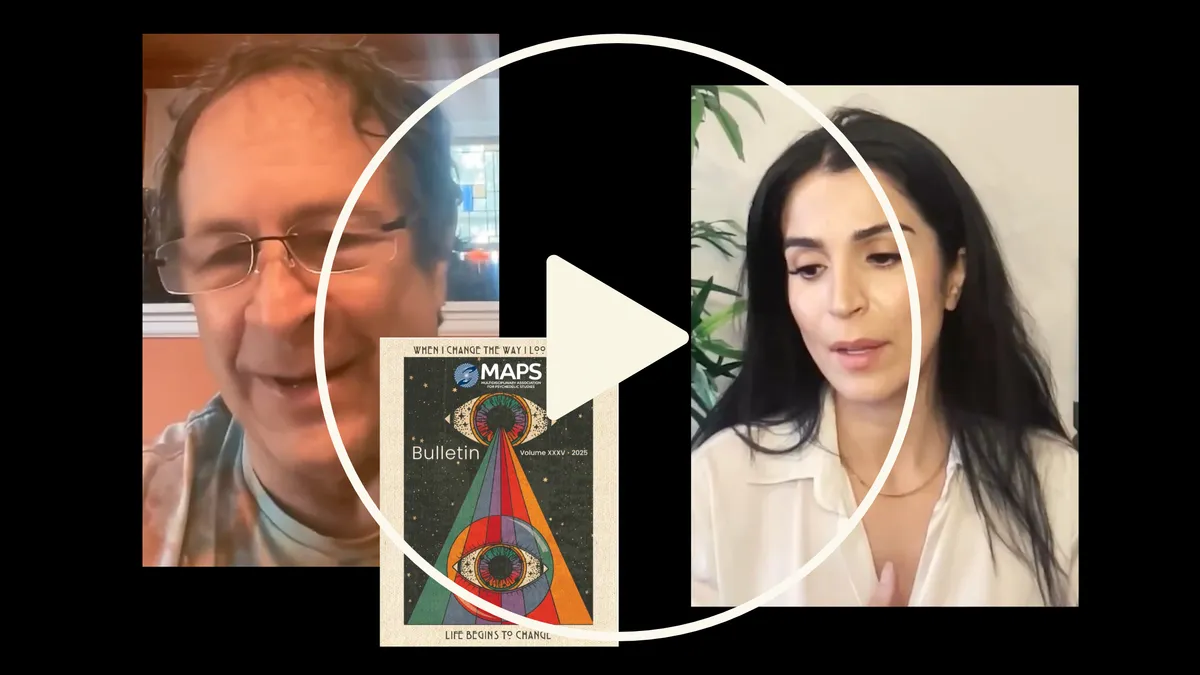
Psychedelics for healing trauma, with Rick Doblin
MAPS founder Rick Doblin on psychedelic therapy for trauma, and why the real healing happens after the session.
Published 29 October 2026What does it mean for the mind to be “manifested”? In this episode, Isabelle talks with Rick Doblin, founder of the Multidisciplinary Association for Psychedelic Studies (MAPS). He has spent more than 50 years working to bring psychedelics into science, therapy and spirituality.
Rick traces psychedelics from the ancient Eleusinian Mysteries to today’s research renaissance. He explains how these substances quiet the brain’s sense of self, why the work people do after a session matters more than the experience itself, and how MDMA-assisted therapy is helping people with PTSD put their trauma in the past. Isabelle also shares her own recovery from panic attacks after a psilocybin session.
They talk about Carl Jung’s idea of the shadow, peace work between Israelis and Palestinians, and Rick’s goal of a world with “net zero trauma” by 2070. It’s a conversation about healing, connection, and what Rick calls the struggle between consciousness and catastrophe.
Note: This conversation was recorded in October 2023. Since then, the US FDA declined to approve MDMA-assisted therapy for PTSD (August 2024), and research is ongoing.
This episode is for educational purposes only and is not medical advice. We do not encourage the use of psychedelics or other illegal substances. Psychedelics are illegal in many countries and can carry serious risks, especially without professional supervision.
Chapters
- Pending
Transcript
Isabelle: So, Rick, could you start off by giving an introduction on psychedelics? What are psychedelics, what kinds are out there, and give an overview for those of us who don't know much about it.
Rick: Okay, that's a very good way to begin. Let me start actually with the definition of the word psychedelic. The word was created in the late 1950s by Humphrey Osmond, and he and Aldous Huxley — the author of Brave New World and The Doors of Perception — they realized that the names they had for these kinds of drugs were pretty negative. One word was "psychotomimetic," meaning it mimicked psychosis. Another was "hallucinogen," meaning it produced things that were not really there — that it was false, a delusion. They felt that didn't really capture what was going on with LSD, with psilocybin, with mescaline from peyote. So Aldous Huxley and Humphrey Osmond were writing back and forth about what the name could be, and Humphrey Osmond proposed this name in a poem: "To fathom hell or soar angelic, just take a pinch of psychedelic." So psychedelic — psyche, we all know, means the mind. And deloun means to reveal or to manifest. So the word means "mind manifesting."
Isabelle: That's a beautiful definition.
Rick: Yeah. And psychedelics have been around for thousands and thousands of years. When we think about what it means to be mind manifesting, that's different from a stimulant. Stimulants give you energy, maybe make it so you don't need to sleep. But dreams are psychedelic — every night when we dream, our unconscious mind is sort of coming to the surface, particularly for people who pay attention to their dreams and think about the emotions and ideas in them. Holotropic breathwork — basically hyperventilation — can be psychedelic as well. You could think of it as there being a barrier between the conscious and unconscious mind, like a membrane, and psychedelics make this membrane more permeable, so you can bring things up to the surface.
There's also been a word proposed — "entheogen," meaning "to reveal the god within" — because some people thought "psychedelic" was too controversial. But I think "entheogen" is propaganda on the positive side, the same way "hallucinogen" is negative. "Psychedelic" is the most neutral word — mind manifesting — and we've tried to reclaim it not just as something associated with hippies from the '60s, but as a tool for science and spirituality.
Now, what are some of the psychedelics? From western culture, from around 1600 BC to 392 AD, the Greeks had a mystery ceremony called the Eleusinian Mysteries — the longest-running mystery ceremony we're aware of in the history of the world. It involved a potion called kykeon that people drank once in their lifetime. You were under pain of death not to say what happened. But it helped people understand life and death — how we're part of something much larger than our own individual birth-to-death journey.
The classic psychedelics — LSD, mescaline from peyote or San Pedro, ayahuasca from the Amazon in South America, ibogaine from West Africa — these are all substances that break down the sense of self. From a neuroscience point of view, there's been discussion about what's called the default mode network — the part of the brain that, when we're resting, scans the horizon for what's significant to us. It's our sense of self, always working for our survival and various needs. The classic psychedelics weaken that sense of self. Aldous Huxley talked about the brain as a reducing valve. Right now, there are other sounds, other things happening around us, but we're not paying attention to them — we're focusing on the conversation. The brain focuses on what the default mode network demands. When you weaken that part of the brain, you have more incoming information that's not organized so narrowly around the self.
That's why people often talk about it as a spiritual experience — they move beyond just their sense of self. It's like the astronauts who go to space and look back at the earth and see it as one thing. The term "ego death" is not a good way to describe it. The world's foremost expert on psychedelics, Dr. Stanislav Grof — now 92 years old — talked about "becoming transparent to the transcendent." Your ego doesn't go away, but it becomes transparent to the transcendent. That's why people often describe these as the most important experiences of their lives, ones that help them find meaning and purpose, a different sense of death — that it's just a natural part of life. Death makes life precious.
These substances have been used for thousands of years for this mixture of spirituality and healing. The mental influence on the body is something I think we generally underemphasize.
Isabelle: Why do you think we need those things? Why would we want to go beyond the default network and the ego — whatever you want to call it?
Rick: I think because you can get a sense of peace, a sense of purpose, a different understanding of death, a sense of the preciousness of life. There was a psychologist called Abraham Maslow who worked on what's called the hierarchy of needs. Your basic needs are survival needs, then you have needs for belonging and self-esteem. Most people are taught in schools that the top of the pyramid is self-actualization — becoming your full self. But toward the end of his life, as Maslow started understanding more about psychedelics, religion, and mysticism, he changed the pyramid. Most people are not taught this in schools, but he moved the pinnacle from self-actualization to self-transcendence — going beyond yourself to realize that we're the products of billions of years of evolution, the products of our families and genetics. We're something. We don't just show up and die out of nowhere.
Isabelle: So it places us in a way where we can understand the trajectory — instead of seeing death as something to run from, it becomes part of the beauty and nature of life.
Rick: Yes. And I think religions have been created to try to help people understand why they're here, what their purpose is. The Catholic Church wiped out the Eleusinian Mysteries, and I think a lot of religions want to position themselves between you and spirituality — it's a power move. Priests, in many religions, mediate between you and the divine. The lesson of psychedelics is that you don't need that — we all need to access it directly ourselves. Certain kinds of religions often become power structures, organizations about money and power. That's why I think the Catholic Church wanted to wipe out the Eleusinian Mysteries — that was a way for people, for about 2,000 years, to have a direct connection to spirituality.
I also want to say that there are other substances I would call psychedelic — mind manifesting — that are not classic psychedelics. For example, MDMA. MDMA is not so much ego-dissolving and doesn't reduce activity in the default mode network in the same way. It kind of opens up the heart. It reduces fear about difficult emotions, but it processes information differently. MDMA is often not called a classic psychedelic, but I would say it's also psychedelic — more gentle, without the visual changes, and yet deep and profound.
Ketamine is a dissociative anesthetic. It's one of the world's essential medicines — it's very safe in anesthesia because it doesn't interfere with your breathing. In roughly one-tenth of the anesthetic dose, it becomes psychedelic, bringing ideas, emotions, and thoughts to the surface. Ketamine has been approved — an isomer of it — for the treatment of depression. One of the biggest mistakes was that it was approved by Johnson & Johnson without any therapy, as a purely pharmacological treatment. That's because the pharma company doesn't understand therapy. Ketamine works better with therapy than without.
Dreams are psychedelic. Meditation can be psychedelic. They're used for this combination of spirituality and healing — emotional healing and the mind-body connection. And what's been a tragedy is that since around 392 AD, when the Catholic Church wiped out the Eleusinian Mysteries, psychedelics have been suppressed in western culture for over a millennium and a half. During the Middle Ages, many women were killed for being witches — often they worked with plant medicines and were an alternative to the dominator culture that said "we're in charge of spirituality." When the conquistadors came to the Americas, the first people they wanted to kill were the shamans, the medicine men, the people who were often the center of their cultures because they helped provide meaning and purpose.
Now, in addition to this long history in western culture through the Greeks, psychedelics were also being used going back thousands of years in South America and Mexico — psilocybin mushrooms, ayahuasca, ibogaine. They appear all over the world because people have this innate interest in seeing the world from a different perspective and getting a deeper sense of things. Psychedelics have been used by humans for thousands of years and they will continue to be used.
We may develop different technologies — virtual reality and so on. I was just in Las Vegas at a new entertainment venue called the Sphere, which cost $3 billion to build. People said it was like psychedelics without the psychedelic. But it wasn't — because these substances, by altering our chemistry in specific ways, produce profound experiences that are different from just receiving a lot of sensory information. It's not surprising that many people say some of the most meaningful experiences of their lives have been under the influence of psychedelics.
We're now in the midst of a renaissance of psychedelic research — there are multiple times as many studies going on now as there were at the height of the 1960s. I think it's partly because humanity is in a massive crisis. We have brilliant technologies, but we're destroying the earth through climate change, and we have incredible destructive weaponry. We don't have the emotional and spiritual maturity to match the brilliance of our minds. And so we're in this terrible, dangerous space. People are hiding in their holes, denying climate change, going numb, and then being manipulated by politicians through fear and anxiety.
For me, the reason I've been focused on psychedelics since I was 18 — and I'm almost 70 now — is that psychedelics have been an antidote to those dangers. We need to rapidly accelerate our emotional and spiritual development because technology is moving forward at such a rate. And psychedelics, by reducing activity in the default mode network, reduce fear, allowing people to process difficult emotions and traumas. We end up realizing that we have far more in common with each other — across cultures, religions, races, genders — than we have differences. That's where psychedelics can help: they give people that kind of experience.
Isabelle: Intelligence without wisdom becomes dangerous. Intelligence without empathy becomes destructive. So while we're rising in intelligence, especially with technology, there's a need for empathy, wisdom, and compassion to follow that rise.
Rick: That's so right. That's the challenge of the age — and the challenge for the next 30 to 40 years — will humanity find ways to accelerate this emotional and spiritual development so that we can appreciate differences rather than be scared of them? And we also have problems of economic systems with massive concentration of wealth while so many people are living in poverty. A lot of people — Elon Musk, Jeff Bezos — are talking about leaving the planet, going to Mars. What they're doing is abandoning the real challenge: how do we learn to live together? They've soiled their bed and want to go somewhere else. But the thing is, we bring the same consciousness wherever we go. We'll recreate the same problems. We really need to figure out how to live together here and save the planet.
Albert Hoffman invented LSD, and his first experience was in 1943 — shortly after the splitting of the atom that eventually led to the atomic bomb. I had the good fortune to know him a little before he died at 102 in 2008. He talked about how LSD came into the world around the same time we discovered the power of nuclear weaponry. His thought was that psychedelics came in order to help us develop the emotional and spiritual maturity so we don't destroy ourselves with the power of our minds. I think that's a good description of the dilemma we face.
Carl Jung, the psychologist, said that the most important political, spiritual, and therapeutic work we can do is to withdraw the projection of our shadow onto others. The parts of ourselves we disown — our shadow, our dark side — we tend to project onto others. That's the whole thing about scapegoats. When rulers have problems in their own country, they develop an enemy, mobilize everyone against that external enemy, and project the shadow onto them — dehumanizing them. The role of psychedelics and therapy in general is to take those disowned parts of ourselves and incorporate them, recognize them as parts of ourselves, as potentials. We don't have to actualize them, but we all have potentials for both good and evil. We need to understand all of them and try to live from a more peaceful, loving place — recognizing that we all have the potential to be evil.
Isabelle: So the whole point about putting blame on somebody else is hoping that if you delete that person or that group, the problem will dissolve. This is the antidote — taking ownership of your shadow in order to eliminate the problem within yourself before you spread it to others.
Rick: Exactly. And the positive side of all this is that we're all interconnected — that's the essence of the classic psychedelic experience: the interconnectedness, the unity of different things. When we realize that the health of little organisms in the ocean can affect the whole ecosystem — that certain whales only live on those organisms and when they disappear the whole system is in danger — that matters deeply.
With MDMA, what we're doing is studying post-traumatic stress disorder. People who've been traumatized don't see the world as it is — they see it through a lens of trauma. People with PTSD are often triggered to feel as if the trauma is happening again. It's never properly put into the past. And so the world is seen through that lens. We see this multigenerational trauma — hurt people hurt people. With MDMA, one of the most important things is that it helps process the trauma, release it, and — through fear extinction and memory reconsolidation — it permits the trauma to be stored in the brain as something in the past, not happening now. And then you can see the world differently.
You know, we should mention what's happening in Israel and Gaza right now. We were about to train Palestinian therapists starting last Sunday — that's been postponed. We do have four Lebanese therapists who were going to come to our training in Iceland in the first week of November. I don't know if they'll still come. We're trying to globalize the therapeutic potential of psychedelics, and in particular to bring people from different cultures that have been at war with each other to try to see through that. We just had a training in Sievo in August with Ukrainian, Bosnian, Serbian, Armenian, Polish, Lebanese, Czech, and Italian therapists — people from all over, from countries that had been fighting and killing each other. But these were the healers trying to work collaboratively to help people from those different cultures. And now, with these little efforts we're making, we see massive amounts of new trauma being created. It's only getting worse in a lot of ways. The hopeful sign for me is this psychedelic renaissance — the way more people will understand our commonality and try to rise through all these fears and projections.
Carl Jung also said we need to understand the psyche, because we are the only real danger to ourselves. He said — and this was in 1959 — "We are the source of all coming evil." Natural disasters are not evil. Human cruelty is evil. So how do we move through that? My TED talk ends with the line: we're in a struggle between consciousness and catastrophe.
Isabelle: That represents reality in a very simple way. I think exploring the space of the human mind and giving ourselves permission to go deeper can neutralize those who aren't able to control their shadow sides. If you have PTSD — as I myself was diagnosed with earlier, and I'm recovered now — I can sympathize with not being able to handle it, because you become the trauma. It's not something separate from you. Conflict resolution would be nearly impossible if you are the trauma, if you are the pain.
Rick: If you don't mind, could you say a little bit about how you recovered?
Isabelle: I had a therapist who recommended psilocybin. I had one session, and — not that I recovered from just that one session — but my panic attacks stopped. I had been having several panic attacks a week for a year. They would come at the worst times — standing in line at the store, and I'd feel like I was suffocating, like I was going to die. It became more and more frequent because I started obsessing that something was wrong with me. I went through regular therapy and it felt good to talk, but in my case, it wasn't sufficient. Cognitive therapy alone wasn't enough.
With psilocybin, it made me go deeper and realize that what I was holding onto was the reason I was triggering the panic attacks. I had the opportunity to let go of whatever I was holding onto — with compassion. And that's something I want to get into for people who don't know much about psychedelics: you go through the trauma, but you wear different lenses. It's not the same as experiencing the trauma with pain. It's almost like you come to a position of observing rather than being the one enduring the pain. You can see yourself as a loving being having this happen to you, with compassion. I find that very interesting and it's why I think it actually worked in my case.
Rick: One of the things about this self-compassion is that it's harder for people to forgive themselves than to forgive others. To have self-love is really difficult. There's actually a project at Harvard doing fundraising right now, combining MDMA with mindfulness-based self-compassion to treat veterans with PTSD.
And that would be the default mode network in charge of that negative self-talk. Yes — you can change it so that you still have the default mode network, but you've changed the narrative in your brain. It's there, but it's not constantly self-critical.
Isabelle: You're engineering your mind journey in a way — everything that's happened to you, you go in and you can kind of edit and make new thought patterns. Is that right?
Rick: From a neuroscience point of view, that's called neuroplasticity. What psychedelics do is make it possible to rewire our brains. They open up these windows of time. And that's why what's so important — and I haven't asked you about it yet — is not just the experience, but the integration: the work you do afterwards to anchor it and develop new thought patterns. Psychedelics make it possible for the brain to rewire itself.
But I want to say right now: it's not just taking the psychedelic. It's being in a safe, supportive context with people who understand what's happening. A lot of times these experiences involve feelings so painful that people feel if they open up to them, they'll be overwhelming — they'll be stuck in terrible places and never come out. But actually, if you open up fully to them, you can integrate them and move beyond. When you resist and keep the feelings at bay, you're never fully processing them. The psychedelics give you the chance to let them out, to metabolize the pain and the memory, so that it becomes part of you but not the whole. It's not just "take these substances and things will get better."
The veterans in our MDMA-assisted therapy studies for PTSD would say, "I don't know why they call this drug ecstasy." People imagine it's a fun drug where your problems just go away — but actually you can feel the problems more intensely. They're just not blocked anymore. They're moving through you. After the storm, the sun comes out, but you have to open up to the storm.
Isabelle: How important would you say integration is in this process, since it's not something you take and your problems disappear? When you've had this opportunity to rewire your brain, what comes after that?
Rick: Integration is essential. When people talk about recreational use versus therapeutic or spiritual use, the main difference is the integration process. Recreational use is just about the experience in the moment — the visual imagery, the altered processing. Therapy and spirituality are about what you bring back from the moment and what change you can make. Huston Smith, a world scholar of religions, talked about the difference between a religious experience and a religious life — and that is the integration process.
The other danger of recreational use is that people often just want the happy experiences. Because of this membrane between the conscious and unconscious, if you've been traumatized and have been pushing things away, psychedelics can bring them to the surface. If you're only wanting good experiences and the difficult stuff comes up and you suppress it, you can end up worse off for months or years. As an example — maybe 20 years ago, within one week, two women contacted us. Both had taken MDMA at a rave and remembered prior sexual abuse. One was with friends who just wanted to party — she felt they didn't want to hear about it, so she stuffed the feelings down. Months later she was worse off. The psychedelic experience actually left her worse off because she didn't integrate it. The other woman was with a girlfriend — the same thing came up, they went to the corner, she talked about it for an hour and worked through it, then they went back to dancing. She thought, "MDMA could be good for PTSD," looked it up, found we were doing research, and contacted us.
It's not just the substance — it's the context. And then without the drug, it's the integration: regular psychotherapy, thinking it through. The goal is to change the baseline of our normal consciousness — what can we bring back to daily life? When you want to develop new habits or ways of thinking, you have to reinforce them. That's this idea of memory reconsolidation — we're able to change the way memory is stored in the brain. And when you're fully able to experience the trauma, it's processed into the past. That's the hippocampus — with trauma, you have less activity there, and you're not able to take traumatic memories and fully put them into the past. Psychedelics, MDMA therapy, LSD, ayahuasca — all these can be helpful for a range of things.
I've had moments where I felt like I was on MDMA even though I wasn't. I took MDMA for the first time in 1982 — 41 years ago. There were moments when, through what I was doing or who I was with, I just naturally felt that way. Sometimes I was around a bunch of people who were doing MDMA and I decided not to, and I worked on a "contact high." Other people around me were modeling what it's like — how you think, how you open up to your emotions.
Sasha Shulgin, the world-famous chemist who developed many psychedelics, talked about his first mescaline experience. He said he realized he wasn't having a mescaline experience — he was having a human experience that the mescaline helped him have. The experiences are not in the substance. That's why it's so important to recognize that dreams can be psychedelic, hyperventilation can be psychedelic, meditation, fasting, endurance athletes sometimes get into these different states. They are human experiences that are difficult to access because we're so focused on survival.
In the past, people didn't live past 30 or 40. There were constant threats to survival. The default mode network was highly refined to be constantly scanning for what was needed. But it's so narrowly focused that we don't have time to look at the big picture — to see how gorgeous and beautiful everything is, to appreciate the life-and-death cycle, to realize how precious it is that we're here.
Isabelle: What in practical terms does integration look like?
Rick: For me, I've found that dreams are a really helpful tool for integration. After people have psychedelic experiences, we often encourage them to pay attention to their dreams. One area we're going to explore is couples therapy. MDMA has incredible potential for couples therapy. In a session, a couple might relax their usual criticism of each other — they learn to be kind. The integration is that afterwards, when the MDMA has worn off, the inclination to be critical might arise, but they can hold back, cycle through that, and be supportive and kind instead. The old habits come up, but you don't have to actualize them. Over time, integration means acting more and more from this deeper place, so that certain things that came in a breakthrough experience become part of your normal way of thinking.
Another way to think about it is gratitude. There's a Brother David Steindl-Rast, a Roman Catholic monk — ecumenical, very mystical — who was open to experimenting with MDMA back in 1983 and 1984. I actually gave him his first MDMA. He used half doses in the monastery to deepen his meditation because it would quiet his mind. One of his books is called Gratitude Is the Heart of Prayer. The idea is to be grateful just for breathing, just for drinking water. Integration means spending more and more of your time with this sense of gratitude — which you may experience during a psychedelic session — and then making it a more permanent part of how you see the world.
Integration can be slow and time-consuming, but it's the necessary work. We don't want people dependent on drugs. With psychedelic therapy, you only have the psychedelics a few times — the opposite of what pharmaceutical companies do. Pharma gives you a drug to control symptoms every day, often for the rest of your life, and when you stop, the symptoms return. Psychedelics with therapy are designed to help people go deep to the root of the problem — the root of the thought, the pain, the experience that happened — and process it, metabolize it. Then, through neuroplasticity and integration, you change the way your brain remembers things and responds, and you can have long-term change.
Isabelle: The patients currently in your testing groups who suffer from PTSD — what integration advice do they receive?
Rick: Let me describe our therapeutic approach. We have three MDMA experiences, each eight hours long, roughly one month apart. There are two therapists — usually male and female, though not always. Within the three MDMA sessions, there are also twelve 90-minute non-drug psychotherapy sessions: three before the first MDMA session, once a week, to develop what's called the therapeutic alliance — a trusting bond between the therapist and the patient where they get to know each other, feel safe, feel supported, and learn about what MDMA is. Then three integration sessions after each MDMA session.
What we teach in our therapeutic approach is that while the experience itself is fundamentally important, even more important is the integration process. That means thinking about it, feeling through it. If there were difficult fear-based emotions, integration means learning how to process those, learning not to run away from them.
There was a study by Dr. Ben Sessa in England on MDMA-assisted therapy for people with alcohol use disorder. Most of those people were running away from trauma — the alcohol was used to blunt the symptoms. When you just deal with the symptoms and cover them up, you never really get better. Once they were able to process the trauma, they didn't need the alcohol as much. But that integration — that processing of trauma during the psychedelic experience in therapy — needs to be reinforced. It's like building good habits: you do them over and over and over, and over time it becomes second nature.
What we've shown in our phase two studies is that after the therapy is over, people keep getting better on their own. We've fundamentally helped people realize that they are their own healers. As therapists, working with the psychedelic medicine, our goal is to help people regain the ability to heal themselves. After therapy there will still be stresses, traumas, problems — and we don't want them to feel like they need another MDMA or psilocybin experience. You've learned how to process difficult emotions so that they don't necessarily overwhelm you. You can break down and cry, feel the fear — but instead of running away from it, you experience it. Over time it becomes easier and easier.
This is a short-term, profound, deep intervention surrounded by therapy — both preparation and integration — with the goal of helping people keep healing themselves for the rest of their lives. There are continual traumas, even just indirect ones from reading the news, hearing about wars, hearing about what's happening with the environment. If we're at all sensitive, there's a constant level of stress that all of humanity is facing right now. How we respond to that is where the psychedelic renaissance is coming at just the right time — at an incredible crisis moment in humanity — to help us survive.
Isabelle: I was wondering if you have some stories to share, just so people can have a short insight into how incredible this can be.
Rick: Sure. There's a book called The Body Keeps the Score by Bessel van der Kolk — an incredibly popular book about trauma. A lot of times when we can't fully process a trauma, it's still stored in our body in some ways.
This story is from 1984, when MDMA was still legal — it became illegal in 1985. I was learning to be a therapist and was sitting with a physician, a German doctor. Under the influence of MDMA, his arm became paralyzed. He was just surprised — he could not move his arm. He said, "We've got to go to the emergency room. I'm a doctor. My arm is paralyzed." And I said, "I'm sure the MDMA didn't hurt your nerves. This is some kind of message from your body. Let's sit with it and see what comes up." Over the next couple of hours, he told a story about how he was with his mother and siblings at the deathbed of their father, who was on all sorts of artificial means to keep him alive and wasn't even really conscious anymore. They had to make a decision: take the father off life support or not. Since he was the doctor, he was the one who wrote the order. But he'd hated his father. So he was always conflicted — did he kill his father? Was it intentional because he hated him? And the arm that wrote that order was the arm that became paralyzed.
Over time, he started working through it: "I did hate my father, but my mother was there saying he didn't want to be left on life support. My siblings all agreed. So even though I did contribute to his death and I did hate him, I wasn't killing him, and I can live with that." By the end of the session, the feeling came back to his arm and he was fine. The lesson is that things you don't even know where they're coming from — if you have patience with them and don't run away — can be processed. We could have turned it into an emergency room visit, and that would have been ignoring the deeper emotional cause.
Isabelle: So the trauma was literally stored in his arm.
Rick: Well, the trauma started in his brain, but it was manifesting in the arm. It was so difficult for him to look at the idea of whether he had killed his father — that thought was so unbearable that it became lodged in the arm that wrote the order. I can imagine there are a lot of stories like that — where people have just buried some type of story, feeling, or guilt, and live with it without looking at it because it's too terrifying. You don't necessarily need to have been to war or had a huge crisis. It could be a split-second decision you didn't take.
Would you say most people are traumatized?
Isabelle: I would say at some level, yes — most people are traumatized to some degree.
Rick: I would agree. But most people, if they come from a loving family, are resilient. Most people who experience trauma can recover — your natural health, positive outlook, and sense of safety and support allow recovery. If people have a healthy childhood, they can be resilient to trauma. Of the people who are traumatized, only about 10 to 20 percent develop post-traumatic stress disorder. Many people experience trauma and, being healthy enough, recover.
There are what are called ACEs — Adverse Childhood Experiences — and there's a checklist: parents divorcing, losing a parent to illness, being homeless, and so on. People who have many adverse childhood experiences and don't have good attachment to their parents feel isolated and alone, and are less resilient to further trauma in their lives. That can sink them into PTSD.
A lot of the soldiers we work with who have PTSD from war often have layers and layers of trauma that predated the war. Here's an example: this was years ago, an Israeli who was in the military. Infiltrators came and machine-gunned several of his fellow soldiers to death in their sleeping bags while they slept. He wasn't there but discovered the bodies. Over time it completely disabled him — he couldn't leave the house, he'd hide under the table. During his therapy, he said it would have been different if they'd died in battle — at least they'd have known what they were doing. Instead, they died helpless. And then he said, "When I was young, my father used to beat me up and I felt really helpless." That childhood sense of helplessness is what made it impossible for him to recover from the adult trauma.
Look at what we're doing to the world — I'd say almost everybody is traumatized to some degree. But most people can recover and are resilient. A substantial number, though, find it's just too much, and they get stuck. That's where therapy comes in.
The Veterans Administration just published a study last year with 914 veterans, comparing prolonged exposure therapy with cognitive processing therapy. What they showed was that about half the people dropped out of both conditions — the therapy was so retraumatizing that they couldn't stand it. We have hardly anybody drop out of MDMA therapy because the MDMA makes it easier to process the difficult emotions.
Isabelle: It forces you to process in an inviting way, because you can have that compassion while going through your traumas.
Rick: Yes. MDMA releases oxytocin — the hormone of love, connection, nursing mothers. A big part of the MDMA experience is this self-acceptance of the complexity of our lives. Once you can accept that, you can start feeling strong enough to look at some of the earlier traumas. Bessel van der Kolk has a paper currently under review showing that people with poor attachment styles at a younger age have difficulty making progress in therapy alone. But when you add MDMA, even these people with difficult attachment histories are able to make a lot of progress.
Isabelle: Is that also one reason you have both female and male therapists during the eight hours?
Rick: Yes. A lot of times the traumas go back to childhood. A friend of mine — actually a former board member at MAPS — decided to become more female, through hormones, a transgender journey. What he said as he became more female was that he had far more words for emotions — his whole understanding of emotional nuance was greatly increased. So I think having a male-female team helps people see things differently. I don't think two therapists are twice as good as one — which is why we want one to be a licensed therapist and the other more of an apprentice, to reduce cost. But the male-female team often works really well, particularly for people with complex PTSD from challenging childhoods, because they never had a fully supportive parental dynamic. You have this kind of transference — the male-female team can be restorative to something you didn't have growing up. And when I've done therapy, I've tried to work with a female co-therapist. Sometimes she'll see things I don't see or say things I wouldn't have said. We're trying to get the best possible results — not thinking economically first, but thinking: how do we get the best possible outcomes?
Isabelle: So there's good reason to be optimistic. And you've recently had the New York Times cover your latest phase three trial. Was there something there that surprised you?
Rick: Let me give some context. We needed two phase three studies — the final stage of research, double-blind, placebo-controlled, randomized. In the first study, published in Nature Medicine in 2021, the journal Science listed it as one of the top ten scientific breakthroughs of the year. What we showed was that of the people who got therapy without MDMA — the control group — roughly one-third no longer had PTSD at the two-month follow-up. When you add MDMA, it's two-thirds — more than twice as effective.
In the second phase three study with moderate-to-severe PTSD, something surprising happened: almost half the people in the control group — who just got the therapy alone — no longer had PTSD. The therapy itself was unusually powerful. I think it's because of the format: an eight-hour session. A lot of traditional therapy is one hour a week. You don't have much time to really relax, get into it, and then process — and then you have to pull yourself together and leave. But an eight-hour session, where people are lying down listening to music with eyeshades, having an inner experience that's flowing and metaphorical, retelling their story, and then the other half of the time talking to therapists — this new modality for therapy, even without the drug, seems to let people go to places they might not reach in a one-hour session.
Our treatment manual is available at maps.org. It's an inner-directed approach — people are able to process their trauma when they're ready for it.
Another thing that surprised me in the first study: since we were reaching out to military veterans — and 40% of the American military is people of color — I assumed we'd have a lot of African-Americans volunteering. We had none. We started looking at why. We realized there are two parts. There's enormous suspicion of the medical establishment among African-Americans, largely due to the Tuskegee experiment — where researchers deliberately withheld a cure for syphilis from African-American patients just to observe how the disease progressed. Completely unethical, and it's a well-known scandal. A lot of African-Americans have to keep their guard up in a racist society. It's hard for them to be vulnerable. The other thing was that we didn't have enough therapists of color. So we thought: if we train therapists of color and try to address the distrust, people will be more likely to volunteer. And in the second phase three study, we had a much larger representation of minorities and had trained many therapists from minority groups. That was really gratifying.
Isabelle: I'm just curious — during the testing, the therapists didn't know who was getting MDMA and who wasn't?
Rick: That's a really complex situation. The ideal in science — the pinnacle of research design — is the double-blind study, where neither the therapist nor the researcher knows who's in the test group and who's in the placebo group. However, when people take a psychedelic, like when you took psilocybin, if someone asked you whether you got psilocybin or a placebo, you'd be certain you got the psilocybin. So it's very difficult to do double-blind studies with drugs that have such an acute, powerful effect.
A big part of my doctoral dissertation at Harvard's Kennedy School of Government, completed in 2001, was about FDA regulation of psychedelics and marijuana. I focused on the double-blind problem and thought I had the solution: therapy with low-dose MDMA versus therapy with full-dose MDMA. I was looking for a dose high enough that people might confuse it with the full dose, but not so high that they got all the therapeutic benefits.
In our phase two research, we tested inactive placebo, 25mg, 30mg, 40mg, 50mg, 75mg, 100mg, 125mg, and 150mg. What we found was that I was partially right and partially wrong. The lower doses — 25 to 50mg — did create some confusion. But they made people uncomfortable. Like turbulence before you get above the clouds. People at those doses still got better, but not as much as those who got no MDMA at all. They were activated without enough fear reduction. The 75mg was very helpful — there was a narrow line between where it's turbulent and where you finally get fear reduction and can make real progress.
We went to the FDA and said — and I quoted a former Harvard president who said "there's always a Harvard man on the wrong side of every issue" — that in this case, it was me. My dissertation was wrong. We recommended therapy with an inactive placebo versus therapy with full-dose MDMA. The other reason was the safety data. In our first study, one woman tried to kill herself twice and another had such severe suicidal ideation that she checked herself into the hospital — and both were in the placebo group. If we'd given a low dose, we might not have known whether the MDMA was responsible. An inactive placebo gives us a better safety profile. The FDA approved this approach.
Over 90% of people correctly guessed whether they were in the MDMA or placebo group — but some guessed wrong, and occasionally therapists were wrong too. Sometimes people in the placebo are so ready to do the work that it looks like MDMA. Sometimes people who get MDMA aren't quite ready, and the response looks muted.
The challenge with using psychedelics in research is that the double-blind is very difficult to achieve. But we have two very successful phase three studies, and we're going to submit the full application to the FDA around December. We hope to have FDA approval around June of 2024.
Then we're going to Europe. But what I'm most interested in now is humanitarian projects — countries with a lot of trauma but not a lot of money. The for-profit company we've created, MAPS Public Benefit Corp, will be making money. But the nonprofit MAPS is now doing work in a humanitarian context. We just had that training in Sievo with therapists from Bosnia, Serbia, Ukraine, and beyond.
The new vision — because once MDMA becomes a medicine, we need a new vision — is a world of net zero trauma by 2070. Like net zero carbon. Net zero trauma doesn't mean no trauma. We know there's both trauma we experience and multigenerational trauma. We work with Rachel Yehuda at the Bronx VA, who has done studies with Holocaust survivors and their children, identifying an epigenetic mechanism by which trauma is transmitted from parents to children. Epigenetics — above the genes — determines what turns genes on and off.
Net zero trauma means reaching a place where the total burden of trauma on humanity is no longer increasing. My guess is that over the next 10 to 20 years, with climate refugees potentially reaching a billion people by 2050, the burden is actually going to get worse. So it's urgent. It'll take multiple generations — hundreds of thousands of psychedelic therapists, tens of thousands of clinics — to really accelerate this healing. By 2070, the hope is that we're no longer contributing to increasing the total amount of trauma, and then we can go to net negative trauma.
To get there, we have to go to marginalized populations — refugee camps, poor countries. One big area is going to be group therapy. How do we administer this in countries where there are hardly any therapists or psychiatrists? We need local healers. There was a project in Africa called "grandmothers on a bench" — they trained grandmothers to listen to people about their emotional problems in the community. Extremely low cost, but effective. How do we find local healers, train them to work with MDMA, and then train the trainers so it continues locally without us having to be there?
Part of what I'm also really excited about is couples therapy — one of the best uses of MDMA — and then, writ large, MDMA and ayahuasca for conflict resolution among groups. There are small groups of Israelis and Palestinians doing ayahuasca and MDMA together. Lear Roseman, a neuroscientist at Imperial College, has taken Israelis and Palestinians to Spain and given them ayahuasca to see if, when you go beyond the default mode network and feel your deep connection, it becomes easier to make peace. One Israeli described how hearing Arabic music during the ayahuasca session first frightened him — it had always made him uncomfortable, it was the enemy — but the ayahuasca slowed him down, and then he could see the beauty of it, could really realize: it's music. We're more similar than different.
And then there's the role of psychedelics in religion and spirituality. There was a study at Johns Hopkins and NYU giving psilocybin to religious leaders. The paper will be published soon, and what they found is that psilocybin was useful to people from all different religions — and it didn't take people away from their religion, but made them more symbolic and less literal in how they understood it. It deepened their religious understanding. The mystics of different religions are closer to each other than they are to the fundamentalists of their own religion. In the future, we hope people will see religions like languages — there are 5,000 languages in the world, all asking how we communicate and make meaning together. Religion can be like that. It comes from cultural background. It doesn't mean you don't believe — it just means you see things in a more symbolic, metaphorical way than a literal one.
Isabelle: It would be such a beautiful world if religion emphasized the beauty within it — the symbols and metaphors that are supposed to be guidelines on how to be human, not just for others but for yourself. And focused less on doctrines, the right and wrong, and more on the love and connection we have through the experience of being human. Do you have a brief story about that?
Rick: I feel that love is the basis of religion — love is deeper than religion. I'm probably the first person in my line in 5,000 years to marry a non-Jewish woman. I brought her family to Israel, we traveled around, and we also went into the Sinai. A Jewish friend of mine had a Muslim girlfriend. The four of us did MDMA on top of Mount Sinai. Two Jewish guys, a Christian girl, and a Muslim girl. We were feeling this universal love and connection — and then we realized we were making every religion angry. In Judaism, it's the religion of the mother — a Jewish guy was with a woman who wasn't Jewish. In Islam, it's the religion of the father — so a Muslim girl was with a Jewish man. And there was this Christian girl marrying a Jewish guy. Every single religion was upset by the fact that the four of us were together in love on MDMA, feeling our common humanity on top of Mount Sinai.
Isabelle: I can imagine that if those people could have a psychedelic experience, they would see the beauty in that scene. It's beautiful. I'm cheering for you. I hope the rest of the world is too.
The obstacle I see with your future projects is legalization — it would have to be legal in most places for this to happen above ground. Because as you said, regardless, people are going to have a relationship with psychedelics — it's not going to stop. But once it's legal and approved, it gives everyone the opportunity to begin healing earlier. You don't need to be in your twenties having to find someone underground. You can start immediately after a trauma. What are your thoughts on the legal aspect?
Rick: That's really important. The FDA — and people are surprised when I say this — has said that if they give us approval for MDMA-assisted therapy for PTSD in adults, we must study adolescents with PTSD. If that works, that would be 13 to 17 year olds. And if that works, we have to study 7 to 12 year olds. The economic case for insurance coverage is that the younger you heal someone, the greater the lifetime benefits. I think the direction we're going to move is toward younger and younger ages and treating people closer to the time of the trauma.
Think of how much pain kids who've been traumatized go through, and how it affects everything. If you could help them restore a sense of self-trust, self-compassion, love, and healthy attachment — that has incredible benefits. Hurt people hurt people. If you can alleviate those years where, because of your own unprocessed trauma, you're creating trauma for others, you're containing it as soon as possible — for your own sake and for the benefit of everyone around you.
Here's a funny story. This was also in 1984, before MDMA was illegal. A family across the street from me — the parents had tried MDMA and really liked it and decided they wanted to do it as a family, including their seven-year-old daughter. They gave her about half a dose and they all did it together. I showed up the next day and talked to the little girl and asked what it was like. She said, "I thought I was in heaven watching my mother, before she got pregnant with me, getting ready to be a mother." I said, "Did you really feel like you were in heaven watching your mother?" And she said, "I don't know. It just felt like that." She wasn't telling it for attention — she was just saying, "Yeah, that's where my imagination went."
About ketamine — as I said, it's a dissociative anesthetic, roughly ten times the psychedelic dose. When ketamine wears off, people go through what's called the emergent phenomena — essentially a psychedelic phase. Adults have more problems with that than kids. Ketamine is used a lot in operations with children because for kids the boundary between what's real and what's imagination is already fluid, so the experience is smoother.
There's also a study done by Gul Dolen, a Turkish-American neuroscientist at Hopkins. She worked with octopuses. Octopuses are solitary creatures — they'll kill other octopuses that enter their territory. Around 600 million years ago, humans and octopuses diverged on the evolutionary tree. But octopuses still process serotonin, and MDMA acts in part on serotonin. She wondered: what happens if you give MDMA to an octopus? After finding the right dose, it turned out that octopuses on MDMA hang out with other octopuses — they become pro-social. You can Google "MDMA and octopus" and find the studies.
What it means is that the pro-social aspects of MDMA are evolutionarily conserved and preverbal. Kids might not be able to express what's happening, but they'll feel it. Gul also worked with mice and showed that MDMA releases oxytocin, and that oxytocin is linked to neuroplasticity — to new synaptic connections and new pro-social parts of the brain. It gets back to how experiences that are so short-lived — six to eight hours — can have implications for the whole rest of your life. That's because of neuroplasticity. There's a lot left to learn, and I think we can build a better world. It's within our grasp.
Isabelle: You're one of my personal heroes, and I'm cheering for all your efforts and your work — past and future. I hope we get the chance to talk again once the FDA approval comes through in June. And just for the people listening — where can they find more about you and your work?
Rick: maps.org. There's a newsletter they can sign up for, my bio, links to my TED talk, and a talk I gave about my origin story — how I came to all of this. And my dissertation — most of it was right.
Isabelle: It's good to be wrong sometimes and good to be right. Thank you so much, Rick, for this amazing conversation. I'm grateful for your work, and I think a lot of people are — and hopefully more will recognize it for this future vision of a better world with less trauma.
Rick: Yeah. And I look forward to talking with you again after MDMA has been approved.
Isabelle: Yes — we'll talk soon. Thank you so much.