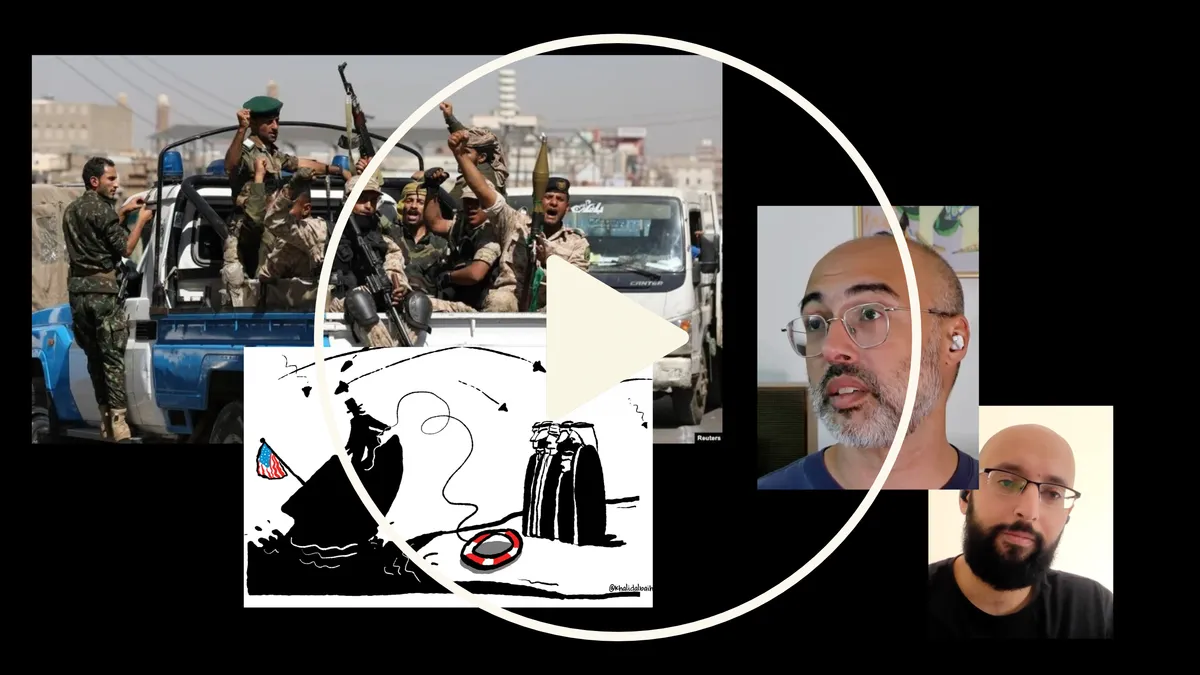
Why can't Saudi Arabia defend itself?
Houthi missiles have hit Riyadh’s airport and Aramco’s headquarters. Iyad El-Baghdadi on why decades of arms deals never gave the Gulf monarchies a way to defend themselves.
Published 27 October 2026Saudi Arabia spends around $80 billion a year on its military, yet it can’t reliably protect its own territory. In this episode, Ahmed Gatnash and Iyad El-Baghdadi look at the arrangement behind that. Oil wealth pays for citizens’ loyalty, the United States provides protection, and a strong, independent army is seen as a risk to the throne. Arms deals worth tens of billions have bought the Gulf monarchies influence in Washington, but they haven’t given them the means to defend themselves.
Drawing on Iyad’s article Blood Without Representation, they discuss why the Saudi army can’t simply go into Yemen, why the UAE pulled back once its soldiers started coming home in body bags, and what a Gulf ruler would have to change to defend his country.
Chapters
- 01:00 Introduction
- 01:50 Watching the Missiles Hit Riyadh
- 05:15 The Rentier Bargain
- 08:30 What the Arms Deals Really Buy
- 12:48 Why the Saudi Army Can't Go Into Yemen
- 18:56 The UAE's "Little Sparta" Experiment
- 22:37 Oil, Vision 2030 and a Squandered Decade
- 27:29 What Would You Tell a Gulf Ruler?
- 35:22 Closing
Transcript
AHMED GATNASH: Welcome back to How to Liberate. This month, Houthi missiles rained down on Riyadh's main airport and hit Saudi Aramco's headquarters. Saudi Arabia cannot reliably secure its own territory. In this episode, I sit down with Iyad to ask why. His answer goes to the kind of state Saudi Arabia is.
We talk about the two bargains the Gulf monarchies were built on, at home and abroad; why buying American weapons has historically been as much about buying influence in Washington as about defence; and why the Saudi army can't simply march into Yemen to finish the war.
The conversation is based on a new article by Iyad titled "Blood Without Representation," which you can find on the Kulna website and which is linked in the podcast description. Kulna is a new editorial platform for long-form thinking about power, resistance and what comes next. More about that at the end of the show.
AHMED GATNASH: Saudi Arabia spends more on its military than anybody else in the region. I think the estimate is about $80 billion a year, which makes it the seventh or eighth highest military spender in the world. When you watched those missiles hitting the Saudi capital this month, what was going through your mind?
IYAD EL-BAGHDADI: To correct you slightly: if you take all of the Gulf states combined, it's around $130 billion. That's more than double what Israel spends, and an order of magnitude more than Iran spends.
What came to my mind initially — I'll be completely honest — was that we had watched the rise of this political order in Saudi Arabia, and the attempts at reform, since the rise of Mohammed bin Salman in the aftermath of the Arab Spring. Those were the memories that flooded my mind. We could see ahead of time that something this bad might happen, and I felt absolutely no satisfaction in being right.
If you remember, Ahmed, the very first two episodes of The Arab Tyrant Manual — the podcast that became How to Liberate — back in November 2017, were all about the Saudi social contract and Mohammed bin Salman's project for the country.
Make no mistake: Saudi Arabia is in a very difficult situation. But the buck stops at Mohammed bin Salman's desk. He made certain decisions and took the country in a certain direction, and this is where we are now — asking whether Saudi Arabia, one of the largest military spenders in the world, can even defend itself. Keep in mind that it was he who started the war on the Houthis in 2015. Before that point, they were a relatively small Yemeni militia. They didn't have these capabilities, and even the experts will tell you that Iranian influence was not that great. The latest figures I've seen suggest the Houthis have gone from around 20,000 fighters to pushing 370,000 over the last decade or so. It's an unenviable position for Saudi Arabia to be in.
There's more than enough analysis out there about the drones, the militias, the map and the infrastructure. In this conversation, we're going to look at the deeper drivers, so that people can understand why this is an existential threat — not only to individual regimes, but to the very model of statehood on which many Gulf countries are built.
AHMED GATNASH: Central to the piece you've just written on Kulna is the rentier bargain in the Gulf states. Can you explain it the way you would to someone who has never lived in the Gulf and seen it with their own eyes? What does a citizen actually get, and what do they give up to get it?
IYAD EL-BAGHDADI: It's interesting that you framed it around someone who has never lived in the Gulf, because if you were born and raised there, as I was, it's often like water to a fish. You don't see the structure around you; you think it's normal. Only when you live outside do you notice that, by international standards, it's actually very strange.
The Gulf states are oil rentier states. In a rentier state, the relationship between citizen and government is flipped: it isn't the citizen who funds the government, but the government that funds the citizen. In a country like Norway — which is also rich in oil — government income comes from taxation. You're taxed at a fairly high rate, you pay a large share of your salary to the government, and it uses that money to run services. That gives you a stake: because it taxes you, it has to represent you. There's a relationship of accountability.
In an oil rentier state, the majority of the state's income comes from oil, and the social contract — the political order — is built on the idea that citizens won't be taxed. The money flows into the state, and the state distributes that wealth to citizens in various ways: comfortable jobs, investments, free housing, very good infrastructure. The citizen becomes a recipient of oil wealth, and the government becomes your boss, your provider and your protector. In that position, you don't really have a claim to accountability, because in the end you are the one being paid by the government, not the one paying it.
So the bargain in the Gulf states is this: as a citizen, you will have a very comfortable life, but in return you will trust the leader to run the country. Political quietism. You won't ask many questions. The future of the country belongs to the leaders. That's why they are monarchies. In the article, I argue that the social contract is more fundamental than the constitution. That's important to understand, because it is the foundation of the political order.
AHMED GATNASH: To go more directly to the core of the piece: you argue that Saudi purchases of American weapons — tens of billions of dollars a year in arms contracts — were never really about defence. So what is Riyadh buying with those contracts with US companies?
IYAD EL-BAGHDADI: I'd adjust that slightly. I think it is about defence, but not only about defence.
Take an oil rentier state — Saudi Arabia, Qatar, the United Arab Emirates. Saudi Arabia is an exception because it's a large country, but many of the smaller states had very small native populations when the oil wealth began to flow. Even in Saudi Arabia's case, for that domestic social contract to work — for citizens to have a comfortable, privileged life — you also need external protection. A comfortable life and fighting dangerous wars aren't compatible.
As we said, in Norway the government taxes me, and therefore I have a claim on what it does. That's why the piece is titled "Blood Without Representation" — a play on "taxation without representation." When you ask for my blood, you have to give me some representation.
But to your question, Ahmed: what are they buying? The short answer is political influence within the protector country. They need external protection so that they don't have to build a strong army or spend heavily on one. An effective army also has to be an independent institution, and if you're an absolute monarchy, it's dangerous to foster an alternative source of authority that has a lot of weapons. Armies can take over; you can have coups. So, for a variety of reasons explained in the piece, the domestic contract requires an external bargain. It requires a protector.
If you are protected, as the Gulf states are, by the United States and US hegemony, there's an important question: how do you make sure your protector will always look out for you? You have to cultivate political influence inside their political system. You have to be generous with politicians and former politicians. We've just seen a very explosive piece about Jared Kushner come out — you cultivate people like that, who can do you favours. Part of that is buying a lot of expensive weapons, because you're doing the president of that country a favour: a lot of money is flowing into his economy because of you.
I'm not saying it isn't about protection. Of course it's good to have very advanced weapons systems. But buying weapons is not the same as having an independent national defensive capacity. That's the point.
AHMED GATNASH: Ultimately, this conflict with Yemen, which was started at the enthusiastic behest of Mohammed bin Salman, is not the kind of conflict you can win by bombing from the air. It's the kind where you have to go in on the ground to actually end it. And Saudi Arabia cannot send its army into Yemen because of this social contract, which doesn't extend to making citizens willing to die for a country in whose direction they have no say.
IYAD EL-BAGHDADI: We have to be careful here. I don't want to imply that Saudis aren't patriotic, or that Gulf citizens don't love their countries or can't fight. That's not true. They have fought, and continue to fight, for their countries. It's just that this isn't legible within the social contract.
As you said, to win a war like this — especially considering that the Houthis, when this started in 2015, were relatively small, perhaps 20,000 men, compared with a much larger Saudi army, and were contained to a specific part of Yemen — if you treat this as an insurgency against the legitimate government, you send in your troops. That's how insurgencies are dealt with elsewhere in the world. If there are raids, drones and missiles being fired at you, you go into that territory.
But there's a distinction between a short, time-limited intervention that achieves its purpose and an open-ended one. This is an insurgency rooted in a group with deep roots in Yemen. If you treat it as a purely military matter — which it isn't, and that's another question to ask — it requires a long-term commitment. And if Saudi Arabia wants to pursue a purely military option, which I don't think would be wise, that is simply not legible within its social contract. That's the short of it.
AHMED GATNASH: Even in a country with a democratic, representative, accountable political system, the government's legitimacy is severely stressed once the country's sons start coming home in shrouds or body bags, especially in large numbers. We're saying that if that starts happening in Gulf countries, which already have a very limited reservoir of government legitimacy, it would immediately put massive stress on the system. I think that's where the catchiest phrase in your piece comes from: blood without representation.
IYAD EL-BAGHDADI: Yes. As I was writing, I was being very careful, because something I noticed long ago is that Gulf citizens have a history as fighters. They were an important part of the Afghan mujahideen — the Arab battalions that fought in Afghanistan — and they were fierce. If you ask about them in Afghanistan and Pakistan, they're remembered as legendary fighters. Arab fighters also went to other arenas: Iraq, Bosnia and the Balkans, Syria. So there's a question: Arab militias can be very fierce, yet Arab armies normally struggle badly. That's been noticed; several books have been written about it.
To your point, Ahmed: even in a country like the United States, an open-ended military confrontation that people don't understand will lead them to ask why they're dying, why their children are being sent to fight halfway across the world.
But I would challenge you a little. If the fight is truly existential and understood to be existential — say the United States is invaded by a neighbour, or by Russia or China, and the fighting is on its border or its soil — I think most Americans would accept that they must fight and die. However, it would change their relationship with their rulers and what they demand of them. They'd ask: who got us into this war? Who made the series of mistakes that led us to fight and die on our own territory?
In the case of Saudi Arabia and the Gulf states, this is absolutely existential. But for these countries to have a fighting army, they first need the population for it. Look at what Kuwait has been doing: actually reducing the number of citizens at a time when it needs a national defensive capacity. That's a door we can open another time.
My core argument is that developing that national capacity requires a national transformation, and I don't trust that they are capable of it.
AHMED GATNASH: And that's before we get into other arguments about the effectiveness of Arab armies versus Arab militias — including that Arab state armies are set up for highly centralised control, eliminating lower-level initiative, whereas decentralised command structures are a common feature of insurgent groups and militias.
But to push back on your argument: the UAE introduced conscription in 2014 and did put troops on the ground in Yemen. Doesn't that contradict your argument about Gulf rentier states and what their social contract allows?
IYAD EL-BAGHDADI: I'm glad you brought it up, because it's an example of a country that attempted this, it didn't work, and it stopped.
In the insecurity of the post–Arab Spring period, the UAE had a moment where it thought it had to become what was called "Little Sparta": to have a militant spirit, embrace interventions — and part of that was recruiting and sending its soldiers into Yemen. Keep in mind that Yemen already has many militias; I think Yemen has more guns than people, and has for a long time. During the Yemeni revolution of the Arab Spring, protesters would check in their weapons before joining a protest, as a symbol that it was nonviolent.
Back to the UAE: it did this, and I'm not saying it can't. The question is whether it can keep doing it while remaining acceptable and understandable within its social contract. When Emirati young men started coming home in body bags — I think they lost 40 to 50 young men in that intervention — the leadership understood it could not go on, because of the reaction from families.
The UAE's social structure is sensitive to this, because a tribal sense persists even generations after statehood. People ask which families these young men come from. Are they from the Al Nahyan, the Abu Dhabi families, the merchant families? As it happened, many were from the northern emirates, who are the junior partners in the federation. That opened very ugly questions about the stability of the UAE, and they couldn't sustain it.
So I come back to this point: it's not that they can't fight, that they aren't patriotic, or that they can't take some casualties. The question is for how long, and how that affects the social contract. Can it sustain heavy, prolonged casualties? And that's before the demographics: the UAE has a population of around 10 million, but only about a million are citizens.
AHMED GATNASH: We're discussing the security of the Gulf states and the stability of their social contracts. It's impossible to have that conversation without noting that this is happening at a time when global oil supplies, and Gulf oil supplies especially, are highly disrupted, at a deeply precarious economic moment for the Gulf. Mohammed bin Salman admitted a decade ago that oil dependence couldn't last — though he's hardly the only person to have noticed that. But he has squandered a decade and tens of billions of dollars on vanity projects and megaprojects, many of which have now been cancelled at great expense, at a time when he could have been moving the country onto a far more secure and stable economic footing.
IYAD EL-BAGHDADI: On the economic component of Vision 2030, I'd advise listeners who want the full context to read the article on the website, because it goes into this in some detail. We look at his entire agenda from when he arrived on the political scene in 2015 and trace what happened to it. The economic element was key.
To summarise: in the aftermath of the Arab Spring, the Saudi public sphere was extremely dynamic — one of the most dynamic anywhere. For a period around 2013, Saudi Arabia had among the highest proportions of active Twitter users in the world; I think more than 40 percent of Saudi residents had an account. People were asking questions about sustainability, the future and representation. One of those questions was whether the system was economically sustainable: if the political order is based on oil, and oil is finite, what does the future look like?
Mohammed bin Salman did something extraordinary: he acknowledged this. He didn't come on the scene and say it wasn't going to happen for many years and wasn't important. He said, yes, this is true, this is not sustainable, and we need a project of national transformation. That acknowledgement made his career — the idea that he was the one who saw it wasn't sustainable and would carry out the transformation. He went on to propose a project, Vision 2030, with an economic component. The promise was: we will become oil-independent, a post-oil state, and we will be even more prosperous — a powerful country, central to the world.
Here is where things turn sad and dark. He published many of his plans, and I can't fail to mention Essam al-Zamil. Al-Zamil was a Saudi economist who went on Snapchat and responded systematically to every point of Mohammed bin Salman's economic plan, explaining why it wouldn't work and what would. The result? Mohammed bin Salman put him in prison, and he is still in prison. There was a systematic destruction of economic expertise. He surrounded himself with people who just said yes to him, and that is inseparable from the tragedy of projects like The Line.
Maybe you can look it up, Ahmed, since you're in front of a computer. I don't know how much was spent on it, but I read recently — you can fact-check it — that simply getting out of the current contracts will take something like $20 billion. So even after cancelling, there are billions of dollars still to be paid.
AHMED GATNASH: I think at least $50 billion has already been spent on The Line alone — a project now entirely written off, with half-finished infrastructure abandoned in the desert.
AHMED GATNASH: A final question to end the conversation. If, for some reason, you were advising a Gulf ruler today, what would you tell them they need to do in the next five years?
IYAD EL-BAGHDADI: That's the question. We've laid out everything that can't work and stated the problem, so why not end with what the solution could be?
I said in the piece, and in the thread on Twitter, that I don't have confidence they're capable of it. But I also said I really hope some of them can. I hope there's a moment when one of those leaders — maybe a young crown prince — says this is the moment to change. The problem is that you're being pushed to do it at the worst possible time, under existential threat. It's a very dangerous moment.
What's really needed is to renegotiate the social contract. If you're a small country, you need a bigger population, which means opening up the deep question of citizenship if you want a large army to protect yourself. I know they're talking about the Mecca Pact — a pact with Pakistan, Syria, Egypt, Turkey and so on. But that will never replace your independent capacity. Do you really want to replace American hegemony with the hegemony of a closer partner that has different geopolitical imperatives, different politics, different interests and a different economy? How will you keep them aligned? It might be a short-term solution, but it isn't a long-term basis for stability. In the end, you have to develop your own native capacity, and for that you need a larger population. You have to open the question of citizenship — and we know many of these countries don't want to open it at all. As we said, Kuwait is actually stripping citizenship from people who have been citizens for generations. That's the first thing.
The second is that you need to reconsider political participation. If you want citizens to fight and die for you, you can't keep saying: I make all the decisions, including decisions that may be catastrophic and lead to ruin and war, and then you go and fight for me. That has to change.
Notice what's required here, Ahmed. We're saying the changes needed are so deep that they affect the very foundation of the political system. It's almost a refounding. It isn't a moderate change; it's a radical change — radical in the sense of being at the root. That's why I'm skeptical. I hope they can do it, but that's why I'm skeptical.
And since you're with us, Saad — you've been pushing me for a while that we need to interview people from Saudi Arabia and from the region — I'm really interested in what smart, independent Saudi, Omani and Emirati voices have to say about this. I was excited by the recent news that our friend and brother Abdullah has taken up the position of secretary-general of the NAAS party, a political party formed by Saudi dissidents. Abdullah, if you're listening, this is an open invitation: come on anytime. We'd love to hear what Saudis and other citizens of the Gulf have to say about this.
One last thing, Ahmed. You know that many Gulf states have large armies of bots. Any time you speak about Saudi Arabia, Mohammed bin Salman or the UAE, you get swarmed by bots that insult you and question your loyalty; sometimes they troll you, try to hack your accounts, or try to dig up things about you. So I'm always skeptical when I see a large number of Saudi, Emirati or Qatari accounts following me. But something different happened after I posted this thread yesterday. Many Arabic-speaking accounts from the Gulf followed me because they actually want to know. These aren't trolls or bots — they're real people who realise this is existential and that they need to understand it. This is an opportunity for us, and maybe we'll also put out an Arabic version of this conversation and the piece, inshallah.
AHMED GATNASH: I really hope someone in the region manages to make that transition against all the odds, because the people of the region have suffered enough. Having seen how one thing leads to another, you would have to be fairly insane to hope for a revolution as your first option for political change. Nobody heads towards revolution willingly. It's the last option, when all others have been attempted and have completely failed. So I really hope we're not heading towards widespread state failure and breakdown in the Gulf.
IYAD EL-BAGHDADI: I'll add something I noticed when people were commenting on the start of the war back in February. I was tracking accounts of Gulf residents — not citizens, but people who were born and raised there. Many of them are very cautious about social media and won't use Twitter or Instagram, but subreddits started appearing on Reddit, and I could see they were genuine people, not fake accounts.
I'm talking about the UAE, because I lived there for most of my life before my expulsion in 2014. Among people born and raised there, I noticed a sense of patriotism and solidarity that even the UAE government acknowledged — there were posters everywhere saying that in the UAE, everyone is Emirati. Of course, if you know the actual rights, they can call you Emirati and cancel your visa the next day. But there was this sense of solidarity and patriotism among people who were born and raised there, perhaps whose parents were born there too. These people absolutely will fight and die for their country; they consider the UAE, or wherever in the Gulf, their country. But not if they aren't included. Not if they aren't citizens. Not if they know they'll fight for the country and then have their visa cancelled the next day.
That's why I say what's required is nothing less than a national transformation. I don't have faith that the current ruling elites will do the right thing. I hope they do, but I don't have faith.
AHMED GATNASH: Thanks, Iyad. I know you have a lot more analysis coming soon on the region and the extensions of these dynamics. Listeners can catch that on our website, kulna.co. Catch you next time, Iyad.
IYAD EL-BAGHDADI: Thank you.
AHMED GATNASH: That's the article, which you can read on Kulna. To sum up: for generations, the Gulf monarchies have asked their citizens for loyalty and nothing more, because the state brings the money and somebody else carries the security burden. That protector is no longer reliable — often absent, and sometimes the actual source of the crisis. A ruler who needs his citizens to fight to defend the country will eventually have to give them a say in how it is run. Iyad doesn't think most of the region's present rulers have the judgment or the courage for that.
That's why Kulna exists. Most analysis of these events is trapped in the present tense, reacting as things happen. What we need, and what we're trying to build, is a space for the longer view. We're talking about a social contract struck generations ago that is still producing today's news cycle. Without thinking at that level, we can't get closer to understanding these crises, which is why we have no solutions to them.
Kulna is rooted in the MENA region, but the forces we write about are global, and so is our scope. We trace how power operates and where it can be challenged. Running through everything we do is a simple conviction: human life and human dignity are not negotiable. Kulna is Arabic for "all of us," because we're not free until we're all free.
If this conversation matters to you and you want to see more of it, share it and support us. You can become a founding member at kulna.co — the link is in the description, and that's where you'll find everything we publish: new and original writing by our roster of contributors, including Iyad, whom you heard on this episode, as well as podcasts, videos and more. Thank you for listening.